

Updated May 6, 2026 · Originally published November 28, 2025 · By

Why Automotive Financing Matters More Than Ever in 2025
Automotive financing is no longer a simple decision between paying cash or taking a loan. In 2025, the U.S. auto market has become more complex, more competitive, and significantly more expensive. Interest rates have fluctuated, vehicle prices have continued climbing—especially for new and electric models—and lenders have tightened their approval criteria. As a result, car buyers face a landscape where understanding financing options is just as important as choosing the right vehicle.
Whether you are buying your first car, upgrading to a new model, refinancing an existing loan, or navigating the system as an immigrant or international student, the decisions you make when financing your car can influence your financial health for years. This extended guide delivers everything you need to know, including insider strategies, lender comparisons, credit-building tips, and detailed explanations of how the financing process works.
What Exactly Is Automotive Financing?
Automotive financing refers to the process of borrowing money from a lender to purchase a vehicle. Instead of paying the full cost upfront, you make monthly payments over a set period, with interest.
Your loan will include:
- Principal: the amount borrowed
- Interest rate (APR): the cost of borrowing
- Loan term: how long you’ll pay (36–84 months)
- Fees: lender or dealership charges
- Monthly payment: principal + interest + optional extras
Financing helps millions of Americans access vehicles they otherwise wouldn't be able to purchase outright. In fact, over 80% of new cars in the U.S. are financed.
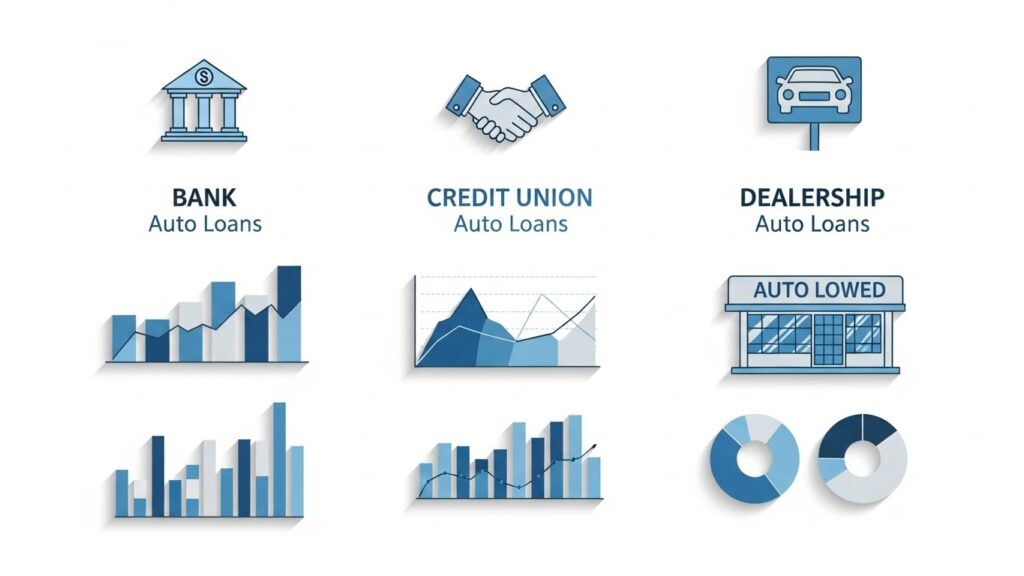
The Main Types of Automotive Financing in the U.S.
1. Bank Auto Loans
Major banks like Bank of America, Chase, and Wells Fargo offer competitive auto loans for new, used, and refinance scenarios.
Pros
- Lower APR than dealerships
- Pre-approval gives negotiation power
- Strong consumer protection
- No hidden add-on pressure
Cons
- Requires strong credit for best rates
- More documentation
- Approval may take longer than dealerships
Best For
Buyers with good/excellent credit who want transparency and control.
2. Credit Union Auto Loans

Credit unions have become one of the best-kept secrets in automotive financing. Many offer APR significantly lower than traditional banks.
Popular options include:
- Navy Federal Credit Union
- PenFed Credit Union
- Alliant Credit Union
- Suncoast
- SchoolsFirst
Pros
- Consistently lower rates
- Member-focused policies
- Flexible approval criteria
- Easier refinancing
Cons
- Must meet membership requirements
- Approval sometimes slower than online lenders
Best For
Borrowers with average credit or those who want the lowest possible APR.
3. Dealership Financing
Dealerships often work with multiple lenders, including captive lenders such as Toyota Financial, Honda Financial, Ford Credit, and GM Financial.

Pros
- Fast and convenient
- Special manufacturer incentives
- Zero-down or 0% APR (for qualified buyers)
Cons
- Add-ons can inflate the loan
- APR may be higher than banks
- Passive buyers risk overpaying
Best For
Buyers who want convenience or limited-time factory incentives.
4. Online Auto Lenders
Online financing platforms have grown rapidly because they offer transparency and speed.

Top providers include:
- Capital One Auto Navigator
- LightStream
- Carvana
- AutoPay
- LendingTree (loan marketplace)
Pros
- Fast approvals (sometimes minutes)
- Compare multiple lenders easily
- Soft-credit pre-qualification
Cons
- Some lenders have strict requirements
- Rates vary widely
Best For
Buyers wanting the fastest, easiest, and most transparent shopping experience.
5. Subprime Auto Loans (Bad Credit Loans)
These loans target borrowers with lower credit scores or inconsistent credit histories.

Who qualifies?
- Credit score below 600
- Limited credit
- Past defaults
- High debt-to-income ratio
- Recent bankruptcy
Pros
- Accessible approvals
- Helps rebuild credit
Cons
- Highest APRs in the market
- Higher risk of negative equity
Best For
Borrowers who need a car immediately and have limited credit options.
How Pre-Approval Works — and Why You MUST Do It
Pre-approval is one of the most powerful tools you have as a buyer. It shows how much a lender is willing to loan you, at what APR, and with what terms.

Benefits of Pre-Approval
- Protects you from high dealership APR
- Gives negotiating power
- Shows your maximum budget
- Helps avoid predatory lending
- Prevents being tricked by low monthly payments with bad terms
A pre-approval typically requires:
- Soft credit pull (no score impact)
- Proof of income
- Employment verification
- Bank statements
- Residency documents
Understanding Loan Terms and Interests
Loan Term (Length)
The loan term has a huge impact on affordability.

Common Terms
- 36 months
- 48 months
- 60 months
- 72 months
- 84 months (risky)
Shorter terms (36–48 months)
- Higher monthly payments
- Lower overall interest cost
- Higher approval difficulty
Longer terms (72–84 months)
- Lower monthly payments
- Higher total interest
- Higher chance of negative equity
In 2025, the ideal balance is typically 60 months, unless rates drop significantly.
APR (Interest Rate)
Your APR is determined by:
- Credit score
- Loan term
- Down payment
- Income stability
- Vehicle age
- Lender policies
- State regulations
Average APR in 2025
| Credit Tier | Score Range | New Car APR | Used Car APR |
|---|---|---|---|
| Super Prime | 781–850 | 4%–6% | 5%–7% |
| Prime | 661–780 | 6%–9% | 8%–12% |
| Near Prime | 601–660 | 11%–16% | 14%–20% |
| Subprime | 501–600 | 17%–28% | 20%–29% |
Down Payments: The Strategy Experts Use

Recommended Down Payment
- 10% for used cars
- 20% for new cars
- 25% for EVs (because they depreciate faster)
Benefits of a Larger Down Payment
- Lower APR
- Lower monthly payment
- Lower total interest
- Less negative equity risk
- Higher loan approval chance
If you have bad credit, a higher down payment can reduce APR by 2–5%.
Dealership Financing: Insider Secrets You Need to Know
Dealerships make significant revenue from:
- APR markup
- Extended warranties
- Gap insurance
- Paint protection
- Interior coatings
The Golden Rule
Negotiate the car price first. Negotiate financing second.
If the dealer tries to mix both, they are hiding numbers.
Automotive Financing for Immigrants, International Students & ITIN Holders
The U.S. auto loan system is difficult for newcomers because most lenders rely heavily on U.S. credit history. However, in 2025, several lenders offer financing for:

- Immigrants with no credit
- People with ITIN instead of SSN
- International students
- New arrivals on visas
- Professionals relocating for work
Best lenders for immigrants
- Bank of America (accepts foreign credit in some cases)
- Capital One Auto Navigator
- Carvana (flexible verification)
- Upstart (alternative underwriting)
- Local credit unions
Documents immigrants may need
- Passport
- Visa
- ITIN
- Employment letter
- Bank statements
- Proof of residency
Refinancing Your Auto Loan
Refinancing is one of the most overlooked financial moves. Many buyers accept a high APR at the dealership but forget they can refinance later.

Reasons to refinance
- Credit score improved
- APR dropped
- You want lower payments
- You want to remove a co-signer
- You were approved with a subprime lender
Potential savings
Most refinancers save:
- $50–$120 per month
- $1,000–$3,000 over the life of the loan
Refinancing takes about 15 minutes online.
How to Boost Your Chances of Loan Approval
1. Improve Your Credit Score
Even a 20–40 point increase can lower APR dramatically.
Quick credit boosters
- Pay down credit card balances
- Remove errors from credit reports
- Avoid applying for new loans
- Keep utilization under 30%
- Become an authorized user
2. Reduce Your Debt-to-Income Ratio
Many lenders require DTI below 45%.
How to reduce DTI
- Pay off small debts
- Consolidate loans
- Increase income (side jobs)
- Avoid opening new accounts
3. Choose the Right Vehicle
Lenders prefer cars that are:
- Reliable
- Not too old
- Not too high mileage
- Easy to resell
Cars over 10 years old or 120,000 miles often require special lenders.
How the Automotive Financing Process Works (Step-by-Step)

Step 1: Check your credit score
Use Experian, Credit Karma, or your bank.
Step 2: Set your budget
Use the rule:
Your car payment should not exceed 10% of monthly net income.
Step 3: Get pre-approved
Compare at least three lenders.
Step 4: Choose the car
New, used, or certified pre-owned.
Step 5: Negotiate price
Always negotiate before financing.
Step 6: Choose loan terms
Select your APR and repayment schedule.
Step 7: Sign the contract
Review carefully—watch for hidden fees.
Step 8: Make payments on time
Missed payments damage your credit.
Common Mistakes to Avoid When Financing a Car

1. Focusing only on monthly payments
Dealers use low payments to hide high interest.
2. Financing add-ons
A $2,000 warranty becomes $2,800–$3,200 when financed.
3. Choosing long terms to lower payments
You’ll pay thousands more in interest.
4. Not getting pre-approved
This gives dealers power over your loan.
5. Buying an overpriced car
Overpaying on price = overpaying on APR.
Leasing vs. Buying (Financing)

Leasing is different from financing because you don’t own the car.
Buying Advantages
- Full ownership
- No mileage limits
- Better for long-term savings
Leasing Advantages
- Lower monthly payment
- Drive new cars more often
- Good for businesses
Leasing Disadvantages
- Mileage penalties
- No equity
- Must return car in good condition
In 2025, leasing has become less popular due to high money factor rates.
The Role of Credit Unions in the Future of Auto Financing

Credit unions continue to dominate the low-APR market. In many states, credit union auto loans are 1%–3% lower than major banks.
More buyers are switching to:
- PenFed
- Alliant
- Digital Federal
- Navy Federal
- State Employees’ CU
Credit unions also offer some of the best refinancing programs.
Electric Vehicle (EV) Financing

Financing EVs is unique because:
- They depreciate faster
- Battery replacement cost is high
- Insurance rates are higher
- Some banks have EV-specific programs
EV incentives
Federal tax credits up to $7,500 are available for qualifying models.
Best lenders for EV financing
- Tesla Finance
- Chase (for EV partnerships)
- Federal credit unions
- LightStream (green loans)
Should You Finance a Car With a Co-Signer?

A co-signer can help you qualify or get a lower APR.
Pros
- Better loan terms
- Higher approval chance
- Builds credit faster
Cons
- Co-signer becomes legally responsible
- Missed payments hurt both credit scores
Future Trends in Automotive Financing (2025–2030)

1. AI-Based Underwriting
Lenders use AI to predict risk using more than credit scores.
2. EV-only loan products
Expected as the EV market grows.
3. More online lenders
Digital-first financing will dominate.
4. Subscription models
Car subscriptions (like Care by Volvo) may grow.
5. Improved immigrant financing
More lenders are adopting flexible credit evaluation.
Conclusion
Automotive financing in 2025 requires informed decision-making. With rising vehicle prices and fluctuating interest rates, buyers must compare lenders, understand loan terms, and negotiate intelligently. Whether you are purchasing new, used, electric, or refinancing, the strategies in this extended guide can save you thousands and help you secure financing that fits your budget and long-term goals.
This comprehensive guide gives you everything you need to navigate automotive financing in the United States with confidence. Use it to make smarter decisions, structure a loan that works for your financial situation, and protect yourself from unnecessary interest or dealership tactics.