
Updated October 23, 2026. This independent guide helps consumers compare personal loans when they have an ITIN rather than an SSN. Approval, rates and lender acceptance vary. No offer is guaranteed.
Contents
- ITIN personal loans: what borrowers should know
- Who may qualify and why eligibility differs
- Documents to prepare before applying
- How to find a lender that actually accepts ITINs
- APR, interest rate and the real borrowing cost
- Origination fees and net loan proceeds
- How repayment terms affect the monthly payment
- Credit history, thin files and alternative data
- How to compare three written offers
- Fraud prevention and advance-fee warning signs
- Privacy and safe application practices
- Using a cosigner or collateral
- Alternatives to borrowing
- Application and post-funding checklist
- Frequently asked questions
- Sources and editorial disclosure
ITIN personal loans: what borrowers should know
Best personal loans for ITIN holders is a search many U.S. borrowers make when they need financing but do not have a Social Security number. There is no universal best lender, and an Individual Taxpayer Identification Number does not automatically qualify anyone for a personal loan. Eligibility depends on each institution's policies, identity verification, credit assessment, income documentation, state availability and loan purpose. The useful comparison is between written offers actually available to the applicant, not an advertisement promising approval.
An ITIN is issued by the Internal Revenue Service for federal tax processing. The IRS expressly states that an ITIN is not identification outside the tax system and does not establish immigration status or work authorization. A lender may accept an ITIN as part of its application process while separately requiring acceptable identity documents and other eligibility information. Applicants should avoid assuming that possession of the number settles any other question.
This guide explains what to verify, how to compare loan disclosures, how origination charges affect the proceeds received, and how to recognize misleading loan promotions. It does not provide a real-time ranking of institutions accepting ITINs. Policies change, and any named provider's acceptance criteria must be confirmed directly before a borrower submits confidential information.
Who may qualify and why eligibility differs
Some banks, credit unions and other lenders may consider applications from customers who use an ITIN, subject to their own programs and legal requirements. Others may require an SSN or additional documents. Whether a lender serves ITIN applicants can also depend on the state, loan type and whether the applicant already belongs to the financial institution.
Business owners, independent contractors, employees and borrowers with varied credit histories may have very different financial documentation. An ITIN is not evidence that the applicant has a particular income, lawful work authorization or borrowing history. When evaluating a loan request, the lender may consider verifiable repayment ability, existing debt, recent delinquencies, account history and any permitted collateral.
Do not use a website's broad phrase 'ITIN loans available' as proof of individual eligibility. Ask the institution whether it accepts an ITIN for the exact unsecured installment-loan product, what additional identification is required, which states it serves and whether there are residency or membership rules.
Documents to prepare before applying
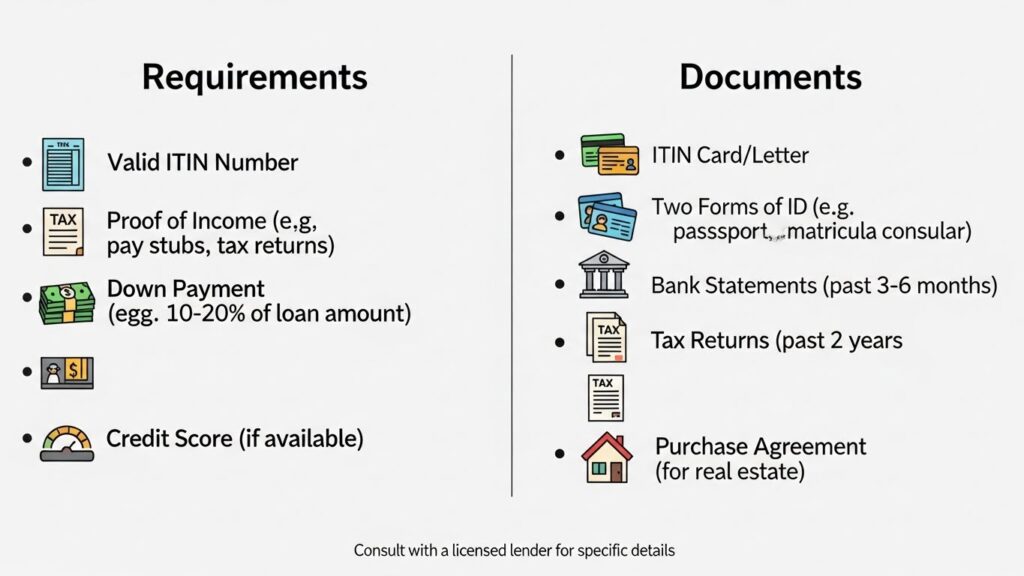
Gather the IRS notice or other permitted documentation of the ITIN if requested, a current government-issued identity document the lender accepts, proof of residence, bank or credit-union account information where required, and support for the income represented in the application. Examples of possible income records include pay statements, tax returns, bank records or business financial documents. The actual requirements are lender-specific.
If an application uses an SSN-only form, do not enter fabricated digits or another person's information. Ask whether the lender has a separate verified application channel for applicants with ITINs. Never assume that an ITIN itself establishes identity; the IRS says it is issued for federal tax purposes and is not an identification document outside that system.
Borrowers with variable or self-employment income should prepare a clear record of earnings and recurring expenses. A lender may look at affordability in addition to gross revenue. Report income accurately and distinguish actual receipts from forecasts. An applicant should not alter documents or claim employment rights based solely on possession of an ITIN.

How to find a lender that actually accepts ITINs
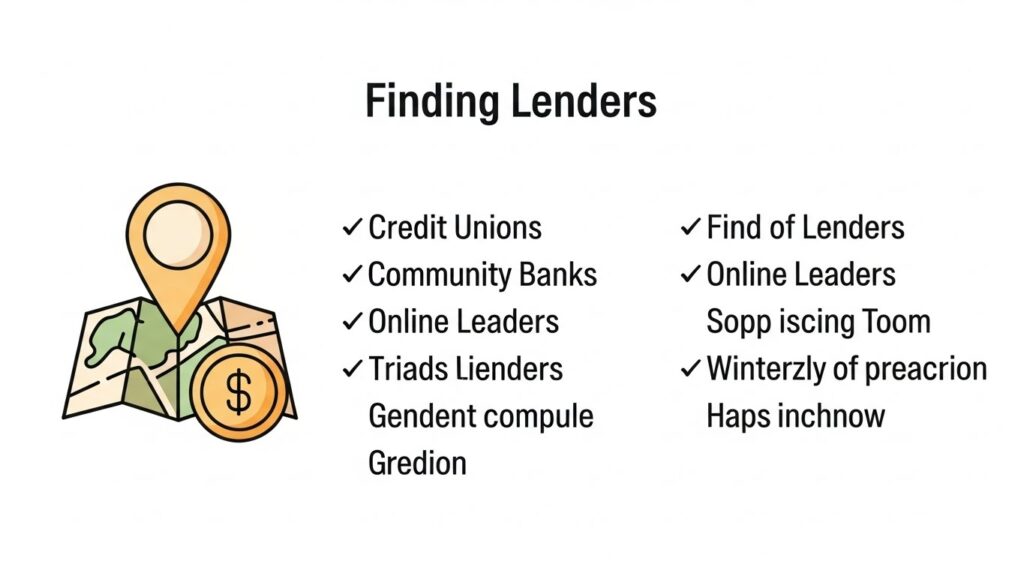
Start with institutions offering consumer installment loans in the applicant's state. Check the official product page, not a third-party lead form, and contact the lender through a verified phone number or secure website. Ask directly whether an ITIN can be used on the relevant application and whether the lender accepts the identification and income documents you possess.
Credit unions may offer relationship-based services but frequently have membership requirements. Community banks may have local programs, while online lenders can have distinct identity-verification systems. None of these categories has uniformly lower APRs or guaranteed approval for ITIN holders. A broad category comparison cannot replace the product's current disclosures.
Ask whether eligibility can be checked without a hard credit inquiry. Prequalification, if offered, is only an estimate, not a binding loan offer. An institution may still conduct a formal inquiry and request documents during underwriting. Keep a record of the name of the institution, date, representative or official page and the precise answers provided.
APR, interest rate and the real borrowing cost
Annual percentage rate, or APR, is a standardized expression of borrowing costs that generally incorporates the interest rate and certain additional finance charges. The contract interest rate alone may understate the effective cost when the lender deducts an origination fee or adds other required charges. Compare APRs for offers with similar terms, and check the actual payment schedule.
A lender that advertises a low starting APR does not promise that rate to every customer. Actual pricing may reflect creditworthiness, verified income, repayment term, state law and product-specific underwriting. Avoid publishing or relying on a generic 'ITIN APR range' without dated evidence from an identifiable lender and matching borrower criteria.
Review the Truth in Lending information where applicable, including amount financed, finance charge, APR, payment amount, number of payments and total of payments. Ask about late fees, optional insurance, payment method rules and prepayment terms. If a figure is not disclosed clearly, do not fill the gap with an estimate from an advertising site.
Origination fees and net loan proceeds
An origination fee may reduce how much cash reaches the borrower or may be financed, depending on the contract. Suppose a hypothetical loan has a face amount of $10,000 and a 5% origination charge deducted upfront. The fee would be $500 and the borrower would receive $9,500. The repayment obligation may still be based on the original principal, making it important to distinguish the proceeds received from the contractual amount borrowed.
This example is arithmetic, not a lender quote or evidence that five percent is a typical fee. A borrower comparing a $10,000 loan without an origination deduction to a $10,000 loan with a deduction has to compare both the monthly repayment and the cash actually available. To obtain the same net proceeds, the principal may need to be larger, if permitted.
Ask whether charges are paid upfront, withheld from proceeds or added to principal. Confirm whether an advertised 'no fee' claim excludes optional add-ons or other costs. The Consumer Financial Protection Bureau cautions that personal installment loans can carry origination, documentation, late or other fees and recommends reading the lender's disclosures.
How repayment terms affect the monthly payment
A longer repayment period often lowers the required monthly payment but can increase total interest. A shorter period may save interest but produce a payment that is harder to meet during an income interruption. Compare both affordability and the lifetime dollar cost rather than ranking options solely on the monthly figure.
For a simple hypothetical fixed-rate $8,000 loan with no fees, compare the amortization schedule over 24 and 48 months using the same annual rate. The longer term normally spreads principal over more payments, lowering each payment while prolonging interest accrual. Real quotes may also assign different rates by term, so request separate accurate schedules for each option.
Evaluate the payment under a conservative monthly budget that includes rent, utilities, food, insurance, taxes, transportation and existing debts. A lender's willingness to approve a loan is not evidence that the payment is comfortable for the household. Keep cash reserves for predictable expenses and unexpected setbacks.
Credit history, thin files and alternative data
Some applicants have little conventional U.S. credit history, while others have established credit accounts associated with their identifying information. A lender may use a credit report and other lawful underwriting data, but practices vary widely. An ITIN alone does not establish a credit score, and a loan does not automatically build a positive history.
Ask whether on-time and late payments are reported to relevant consumer reporting agencies. Check which payment information reaches the borrower's files and under what identifiers. Be wary of vague promises that making any ITIN-based loan payment will instantly create or repair a credit score.
When preparing an application, obtain available credit reports through appropriate official channels and dispute errors with the reporting agency and information provider. A stable repayment record and manageable obligations can matter, but there is no universally reliable score threshold guaranteeing acceptance or a particular APR.
How to compare three written offers
Use the same requested net cash amount and a reasonably comparable repayment term when collecting quotations. For each lender, record whether ITIN applications are accepted, the approved principal, the actual proceeds received, origination fees, APR, repayment term, due dates, total of payments and relevant prepayment conditions. Record whether a cosigner or collateral is required.
A practical worksheet may use columns labeled Offer A, Offer B and Offer C and rows for date, eligibility verified, credit inquiry type, principal, net funds, APR, monthly payment, fees and total repayment. Leave unavailable information marked 'not verified' until the lender supplies it. Do not assume that an estimated prequalification rate will survive final underwriting.
Compare products with distinct costs and risks separately. A secured loan pledging a savings account or vehicle may appear less expensive but exposes collateral to loss if the borrower defaults. A small high-fee advance is not directly comparable to a conventional installment loan merely because both deliver funds quickly.
Fraud prevention and advance-fee warning signs
Loan advertisements aimed at borrowers with limited credit access may promise 'guaranteed approval,' 'instant money' or 'no verification' and then demand a payment before delivering any loan. The Federal Trade Commission warns that advance-fee loan scams frequently use these claims. An upfront demand to pay for a guaranteed result is a serious warning sign.
Verify the lender's legal name, website, licensing or registration where applicable, and actual lending product. Contact the state regulator for questions about an institution's authority to offer consumer loans. Search for complaint patterns, but do not treat reviews alone as conclusive proof of legitimacy.
Never send account passwords, one-time login codes, gift-card numbers or cryptocurrency to obtain a purported guaranteed loan. Legitimate application charges can exist in certain circumstances, but no legitimate institution should sell a promise of approval for an advance payment. Stop and independently verify any urgent request for funds.
Privacy and safe application practices
Identity documents, tax records, bank statements and loan applications contain sensitive personal information. Submit them only through the verified lender's application process and understand the privacy notice. Avoid sending full document images in unsolicited messaging conversations or to an unverified comparison service.
Review whether a lead-generation site will distribute your information to multiple companies. A comparison form is not itself evidence that the named companies lend to ITIN holders or that an offer exists. If the application asks for a source of income or identity document that you cannot lawfully provide, contact the lender rather than improvising a substitute.
Keep copies of the signed agreement, disclosures, payment confirmation and customer-service communications. Use secure account access and verify recipient information before making payments. If a payment method or destination suddenly changes, confirm the instruction through a separate established channel.
Using a cosigner or collateral
A cosigner may help some applicants meet an institution's underwriting requirements, but not every lender permits one. A cosigner is usually legally exposed to the debt, not simply a reference. Before asking anyone to sign, both parties should understand repayment responsibility, credit implications and available notices under the agreement.
Secured personal loans may involve pledged savings or other property, depending on the lender. Collateral does not assure approval and creates a possible loss beyond the loan fees. Ask precisely when the collateral can be seized, how the lien is released and whether the product serves the intended purpose.
Neither cosigning nor collateral fixes the basic affordability problem of a loan whose scheduled payments exceed realistic household cash flow. Review the worst-case outcome alongside the best case and consider whether a smaller loan or different payment arrangement would reduce risk.
Alternatives to borrowing
If the need relates to an unexpected bill, ask whether the service provider offers a payment plan or financial assistance. A nonprofit credit counselor may help evaluate existing debts and repayment options. If the purpose is debt consolidation, calculate the total interest and fees on the new debt and avoid extending obligations unnecessarily.
Before borrowing for a discretionary purchase, compare the benefit with the fixed monthly obligation and opportunity cost. A smaller purchase, delayed expense or savings plan can be preferable when the available credit is expensive. Where emergency liquidity is required, prioritize essential expenses and verified support programs.
For business expenses, a consumer personal loan may have contractual restrictions or may be inferior to a suitable business product. Read permitted-use clauses. A personal loan can also be unsuitable for certain educational or investment purposes, depending on lender terms.
Application and post-funding checklist
First identify an institution whose actual product accepts the applicant's documents and location. Next confirm prequalification inquiry rules and receive a written offer. Read the lender's final disclosures, verify net proceeds, fees, monthly payment, due dates and any prepayment penalty before signing.
After approval, confirm the funding schedule without assuming a same-day deposit. Monitor the designated bank account for the actual receipt and retain the contract. Set a repayment reminder or verified automatic payment according to personal cash flow. If fees are deducted from the amount received, reconcile them with the agreement immediately.
Review statements regularly and contact the lender promptly if income changes threaten timely payment. Do not automatically refinance an expensive loan into a longer one without comparing total costs. If information is disputed, keep records and seek help from the relevant consumer regulator.
Frequently asked questions
Can I receive a personal loan using only an ITIN? Some lenders may accept an ITIN as part of the application, but other identity, financial and eligibility requirements still apply. An ITIN alone is not enough to guarantee credit.
Are the best personal loans for ITIN holders always from online lenders? No. Online providers, banks and credit unions have different policies and pricing. Verify the exact product and compare written offers rather than making a category-level assumption.
Will an ITIN give me authorization to work? No. The IRS explains that an ITIN is for federal tax purposes and does not grant immigration status or permission to work.
Can I be approved instantly? A lender may offer an automated preliminary decision, but approval, additional documentation and funding are not guaranteed. Never pay for a supposed approval guarantee.
Should I compare APR or interest rate? Read both, but APR is generally more useful for comparing loans with different covered finance charges. Also examine the net funds received and total repayment.
Does a personal loan automatically improve my credit? No. Reporting practices, repayment behavior and other credit factors determine potential effects. Confirm how the lender handles payment reporting.
Sources and editorial disclosure
Official sources consulted: IRS ITIN information at https://www.irs.gov/tin/itin/individual-taxpayer-identification-number-itin ; Consumer Financial Protection Bureau personal installment-loan fees at https://www.consumerfinance.gov/ask-cfpb/do-personal-installment-loans-have-fees-en-2120/ ; CFPB APR education at https://www.consumerfinance.gov/ask-cfpb/what-is-the-difference-between-a-loan-interest-rate-and-the-apr-en-733/ ; and Federal Trade Commission advance-fee loan warnings at https://consumer.ftc.gov/articles/what-know-about-advance-fee-loans .
This independent educational article is not a referral offer, a lender approval notice or individualized legal, immigration, tax or financial advice. No institution was verified as currently approving all ITIN holders, and no particular APR or funding timeline is promised. Compare exact terms and qualifications directly with a verified lender.
IRS ITIN guidance · CFPB loan fee guide · FTC loan scam warning