

Published October 18, 2026 · By

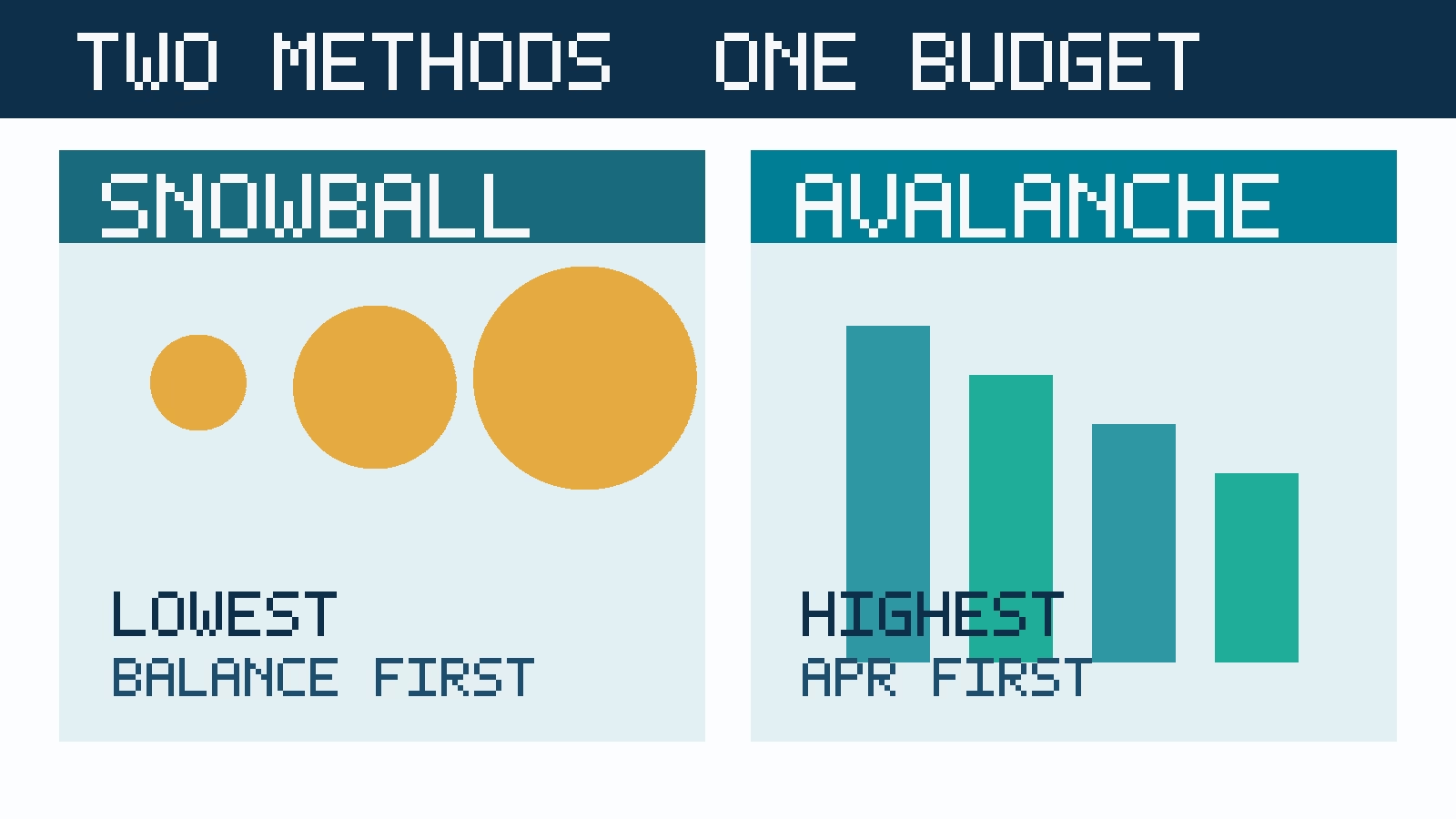
Debt snowball vs avalanche is a choice about where an extra dollar should go after you make every required minimum payment. The debt snowball targets your smallest balance first, while the debt avalanche targets your highest annual percentage rate (APR) first. Both can work if your budget is realistic, you avoid new borrowing, and you keep payments current. The methods differ mainly in the timing of small wins and the interest you may pay.
Picking the mathematically cheapest strategy is useful, but staying with the plan matters just as much. This guide explains the mechanics, presents a transparent three-debt example, and walks through seven decisions that can help you build a repayment plan without making unrealistic promises. It covers credit cards and other unsecured consumer debts; loans with collateral, delinquent accounts, and promotional-rate contracts require additional care.
Editorial scope: General financial education for US consumers. Prepared October 18, 2026. Illustrative calculations are not lender quotes, and this article is not individualized financial, legal, or tax advice. Check your account agreements and creditor statements before taking action.
Quick answer: debt snowball vs avalanche
Choose the debt avalanche if you can consistently direct extra money toward the debt with the highest APR and your primary objective is minimizing interest, assuming balances, rates, fees, and repayment cash flow otherwise remain unchanged. Choose the debt snowball if closing one small account early would make it easier to stay engaged with a long repayment project.
Neither approach means ignoring the minimum due on another account. First fund housing, food, utilities, transportation to work, insurance, and other essential obligations; then meet your required minimums. If those minimums are not affordable, the correct next step is to contact creditors and explore hardship options rather than divert payments to a preferred target. The Consumer Financial Protection Bureau (CFPB) describes both methods and notes their contrasting motivations.
How the debt snowball works
Write down every eligible debt and sort the list from the smallest outstanding balance to the largest. Pay each account's required minimum. Direct all remaining budgeted repayment money toward the smallest balance, regardless of its APR. Once that balance is eliminated, redirect its former payment plus any extra money to the next smallest balance. Keep repeating until the eligible debts have been paid.
The appeal is behavioral: instead of waiting for a large, expensive account to disappear, you can close a manageable account first and see a concrete result. For a household juggling many bills, reducing the number of due dates and accounts to monitor can also lower administrative complexity. These potential benefits are not universal, but they can be meaningful when motivation is a major constraint.
The cost is the trade-off. A small card at 15% APR could be repaid ahead of a larger card at 29% APR. During that time, the more expensive balance continues accruing interest. Snowball can therefore cost more even when it feels faster. The CFPB's debt reduction guidance makes this distinction and recommends putting the payments from cleared debts toward the next one.
How the debt avalanche works
The avalanche uses the same monthly repayment budget but ranks debts by APR from highest to lowest, not by size. Pay every required minimum and allocate the remaining amount to the highest-APR eligible debt. When it is repaid, target the next-highest APR, rolling the freed-up payment forward.
This method is often the interest-minimizing sequence when rates are fixed, you have no payment-allocation restrictions or unusual fees, and there are no urgent deadlines that override the usual ranking. It attacks the rate that causes the largest marginal interest cost per dollar of balance. However, the first visible account payoff can take longer, particularly when the highest-rate balance is substantial.
For credit cards, check how the issuer calculates and allocates interest. Many cards accrue interest daily, and federal rules generally require payments above the minimum on an account carrying balances at different APRs to be applied to the highest-rate balance first, subject to specific exceptions. That within-card rule is different from choosing which separate account receives your extra payment. Consult the CFPB's explanation of credit card interest calculation and payment allocation and each issuer's agreement.
Debt snowball vs avalanche: an illustrative $13,000 example
Suppose a borrower has three unsecured debts, no new purchases, no additional fees, fixed APRs, and a consistent total repayment budget of $700 per month. The table below is hypothetical. It does not describe actual loans, current market rates, or an offer to refinance.
| Account | Starting balance | APR | Assumed fixed minimum |
|---|---|---|---|
| A | $1,200 | 18% | $40 |
| B | $4,300 | 29% | $130 |
| C | $7,500 | 12% | $150 |
| Total | $13,000 | — | $320 |
The modeled budget leaves $380 for the initial targeted extra payment after the $320 in assumed minimums. As each account is cleared, that account's former payment stays in the overall $700 budget and goes toward remaining debt. For simplicity, the model applies each account's APR divided by 12 at the beginning of a monthly cycle, then applies payments, rounds monthly interest to cents, and reduces the last payment if the outstanding balance is smaller. Actual card interest typically depends on daily balances, billing cycles, transactions, and issuer terms, so real statements will differ.
| Modeled outcome | Snowball | Avalanche |
|---|---|---|
| Target order | A → B → C | B → A → C |
| First account cleared | A, month 3 | B, month 10 |
| All debt cleared | Month 22 | Month 22 |
| Total modeled interest | $2,028.84 | $1,919.71 |
| Total modeled repayments | $15,028.84 | $14,919.71 |
In this example, the avalanche saves $109.13 in modeled interest. The snowball delivers its first account closure seven months sooner. Both strategies finish in month 22 at the assumed payment level; that shared duration is an output of these specific assumptions, not a general rule that the methods take equally long.
Before treating any calculator or projection as a commitment, verify the terms in your actual statements. Even a small change in payment timing, a late fee, a variable APR, or a new card charge can change the result. Recalculate whenever your rates or cash flow change.
Seven steps to choose your debt payoff method
1. Separate essential bills from your debt-payoff budget
Begin with take-home income and realistic recurring expenses, including annual bills converted to monthly reserves. Protect housing, food, essential transportation, utilities, and required insurance. A repayment budget that depends on skipping groceries or an insurance premium is not durable. Add a modest emergency buffer when possible so a routine car repair does not force you back onto the card you are trying to pay down.
The goal is a dollar amount you can repeat in an ordinary month, not a one-time extreme payment. If you have irregular freelance or seasonal income, base your minimum monthly commitment on conservative income and direct genuine windfalls to debt only after meeting essential obligations and necessary reserves.
2. Make an accurate list of balances, APRs, and minimums
For every debt, record the creditor, current payoff balance, purchase APR or contractual interest rate, due date, minimum required payment, promotional expiration date, and whether the account is current or delinquent. Look for separate cash-advance or transfer balances on the same credit card. Do not rely exclusively on a credit-report snapshot: it may lag the amount shown on the lender's current statement.
Be especially careful with a loan quoted using a simple interest rate rather than APR. APR can incorporate certain costs, but comparing unlike loan products still requires checking fees and terms. If the lender changes a rate or a hardship program reduces it, recalculate your rankings. Keep your worksheet in a private, secure location rather than publishing account details online.
3. Pay all required minimums before sending extra money
Neither the snowball nor avalanche asks you to miss a minimum payment to accelerate another account. Missing one can create late fees, penalty APR exposure, loss of promotional terms, credit damage, or collection activity. Set reliable due-date reminders or automatic minimum payments if your cash flow can support them without overdrafts.
The CFPB explains in its guide to credit card statement payoff estimates that paying more than the minimum typically reduces interest and speeds repayment; the precise savings depend on the account. Prioritize getting current if an account is already past due, because the consequences of delinquency can dominate a small modeled interest difference.
4. Pick one target rule and keep the total budget constant
For snowball, sort eligible debts by balance from smallest to largest. For avalanche, sort by APR from highest to lowest. If two accounts have the same APR, a reasonable avalanche tie-breaker is smaller balance or earlier due date; if two snowball debts have equal balances, paying the higher-APR one first is a useful tie-breaker. The decision should be written down so each additional payment has a clear destination.
For example, if you have $100 beyond all minimums, apply the full $100 to your designated target. Resist spreading that extra $100 across several cards merely because all of them feel important. The method works by concentrating extra payments while respecting every other obligation.
5. Redirect freed-up payments instead of spending the surplus
When an account reaches zero, its old minimum is no longer due. That does not mean your overall plan should shrink automatically. Redirect the amount you were sending to that account to the next target, provided essentials remain covered. This keeps the total debt reduction effort near its intended monthly level and is the source of the snowball's growing payment effect—an effect that avalanche plans also use.
Check for trailing interest or a final statement after paying off a card. The CFPB notes that interest may continue to be charged under an account's terms until payment is received. Do not mark the account completely finished until the issuer shows a zero balance and any applicable residual interest has been addressed.
6. Compare the cash cost with your ability to stick to the plan
Make two estimates using the same balances, APR assumptions, budget, and minimum payment schedule: one balance-first and one APR-first. Record the projected first debt-free date, total interest, overall payoff date, and the largest payment you would need in a single month. Then consider whether waiting for the first avalanche payoff would reduce your motivation to the point of abandoning the plan.
Sometimes the savings are large enough that an APR-first priority is compelling. In other cases, a modest simulated difference may justify a small-balance win. Rather than claim one choice is psychologically better for everyone, select a plan you understand and can follow. If you switch methods midway, document the change and keep making the required minimums.
7. Review the plan monthly and after any major change
Update balances after statements post and track payments you actually made. Re-run the comparison if a promotional APR expires, a new debt appears, a lender changes terms, or household income changes. If you receive a tax refund or bonus, determine how much can be applied without creating a foreseeable cash shortage. Do not assume that the most aggressive plan is always the most resilient.
Use measurable but realistic milestones: number of accounts paid off, amount of principal reduced, and interest avoided under clearly stated assumptions. Avoid celebrating an account closure by adding new revolving debt. Progress depends on sustained repayment and spending habits, not just the order in which old balances disappear.
When neither standard method is enough
Promotional and deferred-interest balances
A zero-percent introductory APR and a deferred-interest offer are not necessarily the same. On certain deferred-interest plans, failure to pay the promotional balance in full by the deadline can trigger interest calculated from the original purchase date. In that circumstance, a deadline-based priority may be more important than an ordinary snowball or avalanche ranking. Read the promotional disclosure and the CFPB's deferred-interest explanation before allocating extra payments.
Past-due accounts, collections, or lawsuits
If a bill is delinquent, in collections, or the subject of legal action, repayment sequencing is only part of the problem. Confirm the debt and the creditor, understand your rights and applicable deadlines, and avoid acknowledging or paying an unfamiliar collection without investigating it. Meridian Pioneer has a separate guide to debt validation notices and collector verification. Legal consequences vary by state and the type and age of the obligation, so seek qualified local assistance for a lawsuit or possible time-barred debt.
Cash-flow hardship and unaffordable minimums
If required payments exceed what you can safely pay after essentials, a rearranged priority list cannot solve the budget deficit. The CFPB recommends contacting card issuers promptly, explaining the hardship, and asking what payment modifications may be available. See the site’s guide to credit card hardship programs. A qualified nonprofit credit counselor can also help you evaluate options and fees without implying approval or guaranteed savings.
Secured debts and essential assets
A mortgage or auto loan is backed by collateral and may pose risks that do not apply to an ordinary unsecured credit card. Protecting the home or vehicle needed for work can be more urgent than saving a few dollars in credit-card interest. Student loans, medical bills, court judgments, and federal debts can involve different legal rights or repayment programs. Treat them separately when the standard ranking would expose you to a serious avoidable consequence.
Seven debt snowball vs avalanche mistakes to avoid
- Chasing the target while missing other minimums. Delinquency and fees can overwhelm the savings from the chosen order. Keep a due-date calendar and verify each payment posts.
- Confusing interest rate with total cost. Read variable-rate clauses, transaction fees, promotional terms, and the remaining payment schedule.
- Ignoring new purchases. Repeated card spending can offset principal repayment and create a misleading sense of progress.
- Trusting a payoff estimate without its assumptions. Daily interest, fee assessment, and changing minimums can produce a different timeline than a simple monthly calculator.
- Using savings needed for emergencies. A cash shortfall can cause expensive new borrowing or missed essentials.
- Buying debt relief on the strength of a promise. The Federal Trade Commission warns about debt relief scams, including companies demanding fees for guaranteed results.
- Failing to reassess offers with expiration dates. Deferred-interest deadlines, teaser APRs, and balance transfer fees may warrant a different short-term priority.
A balance transfer can occasionally change the economics by reducing an applicable APR, but a transfer fee, promotional window, new application, and post-promotion interest rate must all be included in the comparison. See how balance-transfer credit cards work; do not treat transferring debt as the same thing as paying it off. Also check when credit card grace periods apply before using a card for additional purchases.
Frequently asked questions
Is the debt avalanche always faster than the debt snowball?
No. Avalanche commonly lowers interest under comparable fixed assumptions and can sometimes shorten repayment, but the actual month of final payoff depends on payment size, compounding, fees, and how each lender calculates the minimum. In our illustration, both finish in month 22, even though avalanche incurs less interest. A method you cannot sustain is unlikely to deliver its theoretical advantage.
Which method improves a credit score faster?
No universal answer exists. Credit scoring is influenced by factors beyond payoff order, including payment history, reported balances, utilization, account age, and credit mix. Both plans can support lower revolving balances if they result in consistent payments, but neither guarantees a particular score change. Do not close an account solely because you expect a specified score increase.
Can I use the snowball for two debts and avalanche for the others?
Yes. Some borrowers use a hybrid method, such as paying one very small balance for a motivational milestone and then switching to APR-first. Model any hybrid with the same payment budget and note that it may cost more than a pure avalanche. The priority is maintaining required minimums and having a clear written rule rather than changing targets impulsively every payday.
Should I use a personal loan to consolidate credit cards instead?
Possibly, but consolidation is a separate decision from choosing the payoff order. Compare the new loan's APR, origination charges, repayment term, total borrowing cost, affordability, and consequences if collateral is required. A lower monthly payment can still mean more interest over a longer term. Consider whether you are likely to run up old card balances again.
What if I have no extra money beyond the minimums?
Focus first on maintaining essential spending, making any feasible minimums, and asking creditors about hardship programs. The CFPB's guidance for borrowers unable to pay card bills recommends contacting lenders immediately. The FTC's getting-out-of-debt resource also describes budgeting, negotiating with creditors, and evaluating legitimate credit counseling. A debt management plan is different from debt settlement; review the distinctions in our debt management versus debt settlement guide.
Can I use these methods for student loans or medical debt?
The organizing principles may help, but these debts can carry special terms, protections, programs, and consequences. Medical billing disputes may need resolution before repayment; federal student loans may have repayment choices that a generic credit-card worksheet does not capture. Confirm your obligations and options through the servicer, provider, or appropriate official agency rather than applying a credit-card ranking without modification.
How often should I recalculate my debt payoff plan?
Review it whenever statements arrive and immediately after a material change such as a rate increase, hardship agreement, additional debt, income loss, or promotional expiration. A monthly check is sufficient for many stable budgets. The objective is accuracy without turning the review into a burdensome daily exercise.
Methodology, sources, and editorial transparency
This guide is educational and does not represent independent testing of a particular lender or financial product. The worked example was calculated using three hypothetical starting balances ($1,200, $4,300, and $7,500), fixed APRs (18%, 29%, and 12%), fixed initial minimums ($40, $130, and $150), and a $700 monthly total repayment budget. Interest is approximated monthly as the prior balance multiplied by APR/12; payments are then applied to each required minimum, followed by the target balance. Any unused target payment is immediately directed to remaining eligible debt. Figures are rounded to cents each month, and the final payment is capped at the amount due. No new debt, penalty interest, rate changes, or fees are included.
For general concepts and warnings, we consulted the CFPB's debt reduction guidance, its explanations of card interest and deferred-interest offers, and the FTC's consumer guidance on reducing debt. These are public educational sources, not endorsements of Meridian Pioneer. Source materials and lender-specific terms can change; check the latest contract disclosures before making a financial decision.
Bottom line: The best debt snowball vs avalanche choice is the one that respects your required minimum payments, uses a repeatable budget, accounts for real-world deadlines, and motivates consistent progress. When interest savings matter most and assumptions are comparable, avalanche is a rational default. When a quick, affordable win will help you persist, snowball can be an equally deliberate behavioral choice.