

Published October 20, 2026 · By

Medicare 2027 open enrollment runs from October 15 through December 7, 2026. During that window, people with Medicare can review their 2027 coverage and, if appropriate, change Medicare Advantage or Part D prescription drug plans. Changes generally take effect January 1, 2027. Yet the lowest advertised monthly premium is not necessarily the lowest-cost choice once medical services, prescriptions, provider networks and potential worst-case bills are considered.
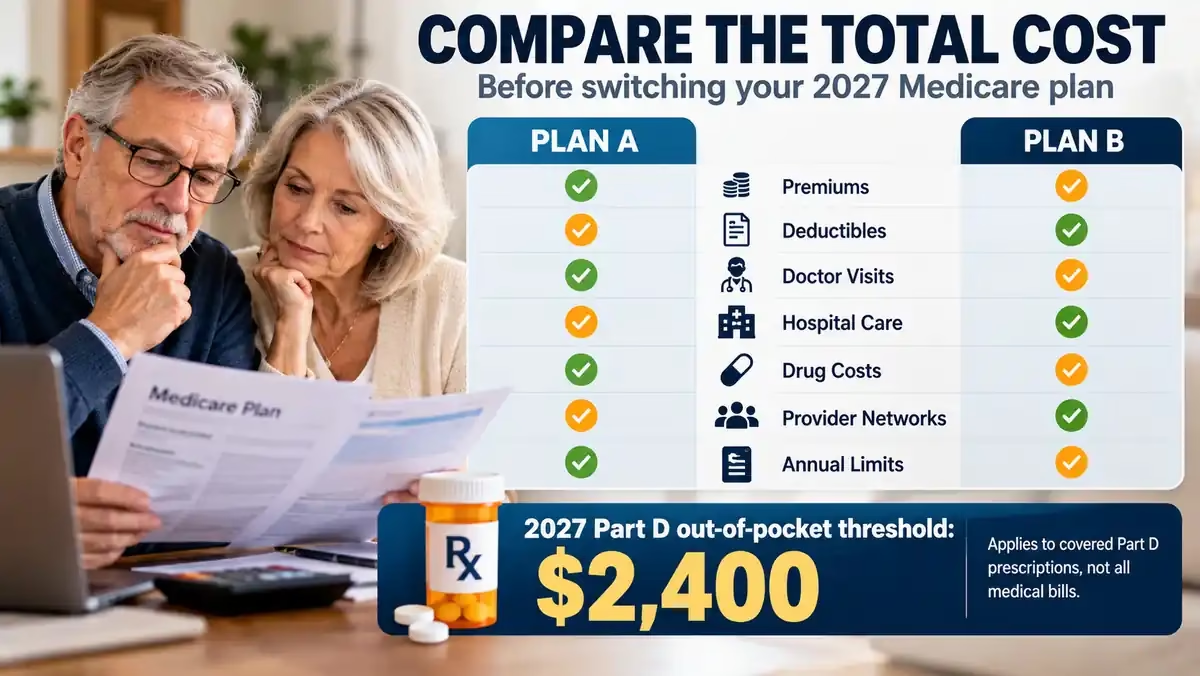
The short answer: compare seven costs before making a decision: (1) combined monthly premiums; (2) medical deductibles; (3) routine-care copays and coinsurance; (4) hospital and higher-cost care; (5) prescription drug costs; (6) in-network versus out-of-network expenses; and (7) your annual out-of-pocket exposure plus services a plan does not cover. Use the official Medicare Plan Compare tool with your own ZIP code, prescriptions, pharmacy and providers. Do not rely on a nationwide premium average as a personalized quote.
Verified 2027 drug-cost figures: the maximum Part D deductible is $700, and the annual Part D out-of-pocket threshold for covered prescription drugs is $2,400. These are distinct from a Medicare Advantage plan's medical out-of-pocket maximum. The $2,400 threshold is not a blanket cap on all healthcare bills, plan premiums or drugs that are not covered. Source: Medicare.gov, Part D costs.
Editorial review: October 20, 2026. This guide provides general educational information, not individualized insurance, legal or medical advice. Medicare rules and plan benefits can vary by year, ZIP code and individual circumstances.
In this guide
Medicare 2027 open enrollment: the dates that matter
The annual Medicare Open Enrollment Period starts on October 15, 2026 and ends on December 7, 2026. Eligible people can switch from one Medicare Advantage plan to another, move between Original Medicare and Medicare Advantage, and change or join an appropriate Part D plan. The plan must receive the enrollment request by December 7 for the change to take effect January 1, 2027. Review your Annual Notice of Change (ANOC), Evidence of Coverage, Summary of Benefits and updated formulary rather than assuming this year's plan will look the same next year.
This window is different from the Medicare Advantage Open Enrollment Period (January 1–March 31), which has narrower options for people already in Medicare Advantage. A Special Enrollment Period may apply after certain life events, but it is not a general extension of the December deadline. If you are satisfied with your present plan, you may not need to switch; annual review remains valuable because premiums, copays, covered drugs and provider arrangements can change. Medicare.gov explains the available actions.
According to CMS's September 28, 2026 release, the weighted average Medicare Advantage plan premium is projected at $12 per month in 2027 versus $14.37 in 2026. The national average for stand-alone Part D plans is projected at $36 per month in 2027 versus $35.09 in 2026. These are program-level averages; actual local offerings and household costs differ. A lower national average cannot establish that a particular plan is a better financial fit. CMS 2027 overview.
1. Monthly premiums: count every recurring payment
The first question should not be, “Which plan has a $0 premium?” It should be, “What recurring amount will leave my bank account for all relevant coverage?” Most Medicare Advantage beneficiaries still need to pay their Medicare Part B premium, even when the Advantage plan advertises a $0 additional premium. Some Advantage plans charge another premium; some offer a Part B reduction, subject to their terms. Original Medicare users may pay separate premiums for Part D and, if purchased, Medicare Supplement Insurance (Medigap).
When appropriate, include Medicare Part A premiums (not everyone qualifies for premium-free Part A), any applicable income-related monthly adjustment amount (IRMAA), and separate dental or vision coverage purchased outside the plan. Do not insert the 2026 Part B premium into a 2027 budget as though it were confirmed for 2027; check the latest officially published figure when it becomes available.
Premium calculation
Annual recurring premiums = 12 × (Part B premium + additional Advantage or Part D premium + any Medigap or other coverage premium), adjusted for applicable premiums or credits. Compare like for like: if Part B premiums are identical in both options, they will not change the relative difference between those options, but they remain a real household expense. In addition, your income can change certain premiums through IRMAA; these surcharges should not be confused with a plan's advertised base premium.
What to verify: the full 2027 premium breakdown, billing timing, any Part B giveback requirements, and whether switching would affect an employer or retiree plan.
2. Deductibles: when coverage starts sharing the bill
A deductible is the amount you generally pay toward specified covered services before an insurance plan begins its usual cost sharing. For Original Medicare, Part A and Part B have different deductible structures. For Medicare Advantage, the medical deductible depends on the particular plan and covered service; some advertise a $0 medical deductible but still charge significant copays or coinsurance when care is received. Drug coverage can have a separate deductible even when the medical deductible is zero.
In 2027, no Medicare Part D drug plan can set its drug deductible above $700, although many offer a lower or zero deductible, or special terms for particular drug tiers. That does not mean every patient will pay $700. The actual amount depends on the plan, covered prescriptions and how frequently they are filled. the official 2027 Part D deductible information.
Ask whether the deductible applies to primary care, specialists, imaging, hospital stays, out-of-network care or prescription tiers. If your care is frequent, a plan with a slightly higher premium and lower deductible might cost less overall. If you rarely require services, the comparison could run the other way; neither conclusion follows from premiums alone.
3. Primary care, specialists and outpatient coinsurance
Routine appointments can be small line items that accumulate over a year. A plan might charge one flat amount for a primary-care visit and a higher one for a specialist, while another plan uses percentage-based coinsurance. If a provider bills for a procedure, test or facility fee on top of an office visit, the final cost may differ from the visit copay advertised in a summary table.
Before choosing a 2027 plan, estimate the number of primary-care appointments, specialist visits, lab tests, outpatient therapies, imaging studies and durable medical-equipment needs you realistically expect. For people with ongoing treatment plans, specialist copays and coinsurance can matter more than an attractive monthly premium.
Copay versus coinsurance: a simple example
A $40 copay generally means a fixed $40 charge for the specified covered service under the plan's rules. 20% coinsurance depends on the relevant allowed amount. For an illustrative $300 covered allowed charge after applicable deductible rules, 20% would equal $60. The $300 example is hypothetical, not a reported Medicare reimbursement amount or quoted fee. Your actual bill may involve multiple services and coverage conditions.
When checking a specialist, verify both that the provider participates in the specific plan for 2027 and the cost-sharing details for the type of service you expect—not merely a generic “doctor visit” line.
4. Hospital stays, emergency care and other expensive services
Hospitalization creates a very different cost profile from routine appointments. Medicare Advantage plans can structure inpatient hospital cost sharing as amounts per day, per admission or other plan-defined terms, subject to Medicare requirements. Emergency departments, observation stays, ambulance transportation, outpatient surgery, skilled nursing facilities and rehabilitation may each have separate rules.
Read the Evidence of Coverage for the scenarios that could materially affect your budget. “Hospital coverage included” tells you little about how much you might owe after a multi-day stay. Confirm whether there are daily copays, covered-day limits, post-acute care conditions, or prior-authorization requirements where applicable. Ask how emergency and urgent care are handled while traveling and how the insurer classifies care received outside its service area.
For Original Medicare, separate Part A and Part B payment rules apply. If you add Medigap, the particular standardized policy may cover some original Medicare cost sharing; it is not interchangeable with Medicare Advantage. This comparison is one reason total annual costs—not a single plan brochure benefit—should drive decisions.
5. Prescription drugs: formulary, tiers, pharmacies and the $2,400 Part D threshold
Prescription costs may be the most consequential difference for someone taking expensive ongoing medications. For 2027, the annual Part D out-of-pocket threshold is $2,400 for covered Part D drugs, up from $2,100 for 2026. The standard deductible limit rises to $700 in 2027, from $615 in 2026. These are official program parameters, not costs that every beneficiary necessarily pays. The out-of-pocket calculation includes certain qualifying amounts paid on your behalf and is governed by Part D rules. Medicare.gov.
Crucial distinction: the $2,400 threshold applies to covered Part D prescription drug spending counted under the program's rules. It does not set a $2,400 maximum for hospital services, doctors' bills, plan premiums, most drugs excluded from Part D coverage, or unrelated healthcare costs. Reaching the threshold generally means no further cost sharing for covered Part D drugs during the rest of the calendar year.
How to compare prescriptions correctly
Make a list of each medication's exact name, strength, dosage, quantity and frequency. In Medicare Plan Compare, inspect whether the 2027 plan covers the medicine on its formulary, what tier it is on, whether step therapy or prior authorization applies, and whether a preferred pharmacy offers lower costs. Compare the same prescriptions and pharmacies under each plan. A lower premium cannot compensate for an essential drug becoming nonformulary without a workable covered alternative.
Medicare's Prescription Payment Plan can spread eligible out-of-pocket prescription costs over monthly bills. It can smooth cash flow, but it does not lower the total cost of the medications. If you have limited income and resources, check whether Extra Help or a Medicare Savings Program could lower costs instead. Medicare payment plan guidance; Extra Help information.
6. Provider and pharmacy networks: the cost of going outside them
Networks affect both convenience and cost. Many Medicare Advantage HMOs use defined provider networks, while some PPOs permit certain out-of-network services at higher cost sharing. Original Medicare generally allows beneficiaries to visit any U.S. doctor or hospital that accepts Medicare. These structural differences should be checked for each coverage option rather than assumed from the brand name. the official coverage comparison.
Call your primary physician, specialists and hospital and ask whether they expect to participate in the specific 2027 plan and network. An insurance company name by itself is not sufficient. Also verify relevant lab facilities, outpatient clinics, imaging centers and pharmacies. Network directories can change, so use the plan's current directory and seek direct confirmation for critical providers before enrolling.
Pharmacy placement has a similar financial effect. Preferred and standard participating pharmacies may have different copays or coinsurance; a nonparticipating pharmacy can create additional restrictions or costs. If your current prescription regimen requires specialty medication, verify handling of specialty pharmacies and shipment arrangements. Travel frequently? Compare routine out-of-area care, not just emergency coverage.
7. Annual out-of-pocket exposure, exclusions and benefit limits
For Medicare Advantage, compare the medical maximum out-of-pocket (MOOP) amount for Medicare-covered Part A and Part B services. Plans have an annual limit for covered medical services, but the plan's precise limit and whether in-network and combined in/out-of-network limits differ depend on its design. The MOOP does not generally include monthly premiums or every type of care and benefit. If you have high ongoing medical expenses, a lower MOOP can provide valuable protection.
Original Medicare by itself generally has no annual out-of-pocket maximum for Part A and Part B services. Qualifying supplemental coverage—such as Medigap, Medicaid or certain employer coverage—can change an individual's financial exposure. You cannot compare Original Medicare plus a Medigap policy with Medicare Advantage merely by comparing their monthly prices. Official comparison.
Also examine the actual limits on dental, vision, hearing, transportation, fitness or other extra benefits where offered. “Dental included” might involve a capped allowance, restricted network or exclusions. Benefits that do not fit your needs may have little personal financial value. Confirm whether hearing devices or dental treatment are covered, at what annual amount and with which providers. Services outside your plan's covered benefits can lead to out-of-pocket bills that never count toward the plan's medical maximum.
Best practice: record both your estimated typical-year cost and your maximum plausible exposure for covered services, while recognizing that premiums and excluded or noncovered charges may remain outside certain limits.
Two hypothetical 2027 plans: why $0 can cost more
Consider two illustrative, fictional Medicare Advantage designs with drug coverage for a beneficiary who expects five primary-care appointments, six specialist visits, a four-day inpatient stay and several covered prescriptions. For simplicity, assume no applicable medical deductible in these particular examples and the following costs, all below applicable plan benefit limits. These figures are not actual plan quotes and are not national averages.
| Illustrative annual item | Plan A ($0 additional premium) | Plan B ($40/month additional premium) |
|---|---|---|
| Extra plan premium (12 months) | $0 | $480 |
| Five primary-care visits | 5 × $10 = $50 | 5 × $0 = $0 |
| Six specialist visits | 6 × $50 = $300 | 6 × $25 = $150 |
| Four covered hospital days | 4 × $350 = $1,400 | 4 × $225 = $900 |
| Covered Part D drug out-of-pocket cost | $720 | $520 |
| Illustrative annual subtotal | $2,470 | $2,050 |
In this invented scenario, Plan B has $420 lower estimated annual costs despite charging $480 in additional premiums. The comparison excludes the same Part B premium assumed under both plans, any IRMAA, other medical services, excluded items and any individual subsidy. Actual out-of-pocket costs depend on each plan's formulary, benefit terms, network and the beneficiary's circumstances.
Now reverse the scenario: someone with few visits, no hospital admission and low drug use could favor Plan A. The lesson is not that a paid plan always wins; it is that the correct cost answer depends on expected utilization and protection against high bills. Use official plan materials to replace every invented amount with the actual 2027 plan figure.
A practical Medicare 2027 comparison checklist
- Gather your documents: 2026 plan card, 2027 Annual Notice of Change, Evidence of Coverage, medicine list and preferred provider/pharmacy list.
- Enter your ZIP code: use Medicare Plan Compare to view plans actually available to you for coverage year 2027.
- Compare total premiums: include Part B, any applicable IRMAA, additional plan or Part D premiums and possible Medigap costs.
- Estimate medical spending: count routine office visits, specialist visits, therapies, hospital risks and other likely services.
- Run your exact drug list: check formulary inclusion, tier, restriction, pharmacy and the projected full-year cost.
- Verify networks directly: confirm doctors, hospitals and pharmacies under each plan for the upcoming year.
- Review the annual risk: compare each Medicare Advantage medical MOOP or any Original Medicare supplemental coverage and identify important exclusions.
- Read the official materials: note prior authorization, referral rules, noncovered extras and deadlines rather than trusting marketing summaries alone.
- Get independent help if needed: contact your State Health Insurance Assistance Program (SHIP) or 1-800-MEDICARE for free coverage counseling.
- Save your confirmation: if switching, keep the enrollment confirmation and check that new coverage starts on January 1, 2027.
For further context on plan structures, see Meridian Pioneer's Medicare Advantage comparison for Texas and overview of Ohio Medigap options. Those articles discuss prior-year or state-specific products; use them for background, not as substitutes for verified 2027 quotes.
Three switching mistakes that can become expensive
Assuming Medicare Advantage and Medigap are interchangeable
Medigap is supplemental insurance designed to work with Original Medicare. It generally cannot be used to cover cost sharing under Medicare Advantage. Depending on your state, enrollment history and guaranteed-issue rights, switching from Medicare Advantage to Original Medicare and trying to buy Medigap may require medical underwriting. Outside certain protected periods, an insurer may be able to decline a new Medigap application. Check Medigap eligibility before giving up existing coverage. official guidance on Medigap applications.
Dropping prescription coverage without checking penalties
Some beneficiaries who go at least 63 consecutive days without creditable drug coverage may face a Part D late-enrollment penalty when they later enroll. The consequences depend on their enrollment and coverage history. Before leaving a Part D plan, verify that any replacement arrangement maintains appropriate drug coverage. Medicare guidance on switching and dropping drug coverage.
Ignoring employer, union or retiree health coverage
A switch may affect coordination with employer, retiree or union coverage, including benefits available to a spouse or dependent. Contact the benefits administrator before changing coverage. An incorrect assumption about coordination can produce gaps or costs that do not appear on a simple Medicare plan comparison page.
Frequently asked questions about Medicare 2027 open enrollment
When is Medicare Open Enrollment for 2027 coverage?
It runs from October 15 through December 7, 2026. Valid elections made during this period generally take effect January 1, 2027.
Is a $0 Medicare Advantage premium plan free?
No. A $0 additional plan premium generally does not eliminate the Part B premium, medical copays, deductibles, drug costs, or uncovered services. Actual costs depend on the specific plan.
Does the $2,400 Part D limit cover hospital and doctor bills?
No. The 2027 threshold concerns qualifying out-of-pocket spending for covered Part D prescription drugs. Medical cost-sharing is governed by separate Part A/Part B, Medicare Advantage and supplemental coverage rules.
Does every 2027 Part D plan charge a $700 deductible?
No. $700 is the maximum allowed annual Part D deductible for 2027. A plan can charge a lower deductible, including zero, according to its terms.
Can I keep my current coverage without switching?
Often yes, if the plan continues to serve you and you remain eligible, but you should review next year's official plan changes and any notices about nonrenewal, service areas or altered benefits.
Will I be guaranteed a Medigap policy if I leave Medicare Advantage?
Not always. Guaranteed-issue rights depend on timing and circumstances, and state protections vary. Verify your eligibility and Medigap availability before changing coverage.
Can the Medicare Prescription Payment Plan lower my drug bill?
No. The payment arrangement helps distribute eligible out-of-pocket drug expenses over time; it does not reduce the total price or create an additional discount.
Where can I find independent help?
Use Medicare.gov, call 1-800-MEDICARE, or contact your local State Health Insurance Assistance Program. Never disclose your Medicare number to an unexpected caller offering unsolicited “free enrollment” help.
Bottom line: price the entire year, not the premium advertisement
The right question for Medicare 2027 open enrollment is not which advertisement displays the smallest monthly amount. It is which coverage arrangement fits your doctors, medications, health needs and financial tolerance after the complete year's costs are considered. Calculate premiums, foreseeable copays, deductibles and prescriptions; then compare worst-case covered medical exposure and crucial exclusions.
If you decide to switch, do so through Medicare or another authorized enrollment channel by December 7, 2026. If you are unsure about provider networks, Medigap rights or ongoing treatment, obtain confirmation before changing a plan that may be difficult to replace.
Official sources and verification notes
- Official Medicare guidance — Open Enrollment (dates, eligibility and effective date).
- Official Medicare guidance — Prescription Coverage Costs (2027 deductible and covered-drug out-of-pocket threshold).
- CMS — 2027 Medicare Advantage and Part D Outlook, published September 28, 2026 (projected national average premiums, not plan quotations).
- Official guide — Coverage Types Compared (network and annual medical out-of-pocket distinctions).
- Official guide — When and How to Buy Medigap (medical underwriting and guaranteed-issue considerations).
- Official guide — Prescription Payment Plan (payment timing versus total drug costs).
- Official guide — Switching Drug Coverage (coverage transitions and potential penalties).
Sources checked October 20, 2026. All example plan prices and utilization figures in the comparison table are hypothetical and are labeled accordingly. Actual 2027 plan pricing and benefits must be confirmed with Medicare Plan Compare or official plan documents by ZIP code.