
An identity theft credit report block under FCRA Section 605B can help remove fraudulent accounts and other identity-theft information from consumer reports. Federal law generally requires covered reporting agencies to block qualifying information within four business days after receiving a complete request. This guide explains the documents, exceptions, and follow-up steps without promising deletion of legitimate debt.
Table of Contents
What FCRA Section 605B actually does
Section 605B of the Fair Credit Reporting Act, codified at 15 U.S.C. 1681c-2, gives identity theft victims a way to request a block of information caused by identity theft. It is not a general-purpose method for erasing legitimate late payments, valid debts, or inconvenient credit history. The request concerns specific fraudulent information in a consumer reporting agency's file.
When the statutory conditions are met, the agency generally must block reporting within four business days after receiving the complete documentation. That timing starts upon receipt of all required materials, not when someone first notices the problem. The statute contains exceptions and permits a block to be declined or rescinded in defined circumstances.
The four documents the law requires
A valid Section 605B request ordinarily includes appropriate proof of your identity, a copy of an identity theft report, identification of the fraudulent information, and your statement that the information does not relate to any transaction you made. Missing one of these elements can delay a request and lead to confusion about the four-business-day rule.
Review the statutory wording at 15 U.S.C. 1681c-2. Assemble a separate, complete package for each consumer reporting agency showing the fraudulent item. Preserve the originals and submit copies through an official secure channel.
Start with an FTC identity theft report
The FTC's IdentityTheft.gov offers an identity theft report and recovery plan. Describe what happened accurately, including which accounts or inquiries were opened without permission. Save the completed report and confirmation information in a secure location.
Never embellish a claim to force a faster credit-report change. The Section 605B process is designed for actual identity theft. If the dispute concerns a reporting error unrelated to stolen identity, use the ordinary credit reporting dispute process instead.
Identify every fraudulent tradeline
Get current credit reports from AnnualCreditReport.com. Review account names, balances, payment history, collection entries, addresses, and inquiries. Mark precisely which entries resulted from identity theft. A broad request to delete everything negative is not a reliable statutory submission.
Include the creditor or collector name, account number suffix if available, approximate opening date, and why the account is not yours. If multiple bureaus display different details, tailor each package to that bureau's report rather than relying on a generic statement.
Write the nonparticipation statement
Section 605B requires a statement that the identified information does not relate to any transaction by the consumer. A clear example is: I did not open, authorize, benefit from, or conduct the transactions associated with the listed account. Use only statements that are factually true for your circumstances.
If a family member used your information, the legal analysis may be complicated by consent, apparent authority, and who obtained the goods or services. Do not guess. Preserve messages, statements, and other evidence, and seek legal advice where the facts are disputed.
Submit the request to each relevant bureau
A block request should be sent to each consumer reporting agency that is reporting the fraudulent information. The three nationwide credit bureaus are Equifax, Experian, and TransUnion, but specialty agencies may also hold relevant records. Use verified official contact information, not a third-party paid removal service.
The FTC provides a sample Section 605B letter. Its mailing addresses may change, so verify current submission methods with each bureau before sending sensitive identification. Retain delivery proof and a dated copy of the full packet.
What happens within four business days
After receiving the four statutory items, a covered consumer reporting agency generally must block the reporting of the identified identity-theft information no later than four business days afterward. The clock is not a promise that every downstream website, score, lender database, or collector record will update instantly.
The agency also must promptly notify the furnisher of the identified information that identity theft has been reported, that a block was requested, and the effective dates of the block. See the Federal Reserve's reproduction of Section 605B.
Block versus ordinary credit dispute
An ordinary dispute under FCRA Section 611 generally asks a bureau to investigate whether reported information is accurate and complete. Section 605B provides a distinct identity-theft blocking procedure triggered by specific documentation. The processes have different legal standards and timing requirements.
If the account is yours but the balance, date, or payment status is wrong, use the ordinary dispute route. If the account was opened through identity theft, identify it as such and include the required report. You may need both processes for different items on the same file.
Block versus credit freeze
A credit freeze limits access to your report for many new-credit applications. A Section 605B block suppresses particular information resulting from identity theft. A freeze generally does not remove an existing fraudulent tradeline, while a block does not prevent someone from attempting future identity theft.
The FTC explains that credit freezes are free and can be placed with all three nationwide bureaus. See our credit freeze versus fraud alert guide for prevention options. Victims often need a freeze and a targeted block for different reasons.
Fraud alert versus identity theft block
An initial fraud alert instructs potential creditors to take steps to verify identity before opening new credit. An extended fraud alert has additional requirements and lasts longer. Neither is equivalent to blocking a specific fraudulent account from reporting.
Choose the tools based on the problem: freeze to restrict new access, fraud alert to flag risk, Section 605B block to address identity-theft entries, and account closure to stop ongoing misuse. No single tool replaces careful monitoring and communication with affected financial institutions.
When a bureau can refuse or reverse a block
The statute permits a bureau to decline or rescind a block if it reasonably determines that the information was blocked in error, the request was based on a material misrepresentation, or the consumer obtained goods, services, or money through the transaction. These are substantive exceptions, not permission to reject any inconvenient request.
A bureau that declines or rescinds a block must provide prompt notice under the statutory framework. Ask for the specific reason, preserve the notice, and compare it with your documentation. Do not assume that an automated response resolves the legal merits of your case.
What to do after a denial
Read the bureau's letter carefully to identify missing proof, disputed facts, or an assertion that the transaction benefited you. Correct incomplete documentation promptly. If the bureau appears to misunderstand your report, send a concise response referencing the original submission and enclosing relevant evidence.
You can submit a complaint to the CFPB after attempting to resolve the issue with the company. Legal aid or a consumer-law attorney can evaluate whether further action is appropriate. A complaint does not guarantee removal.
The role of creditors and furnishers
A furnisher is a creditor, collector, or other company supplying account information to a reporting agency. After a Section 605B block, the agency must promptly notify the furnisher. The law also imposes restrictions on certain identity-theft-related reporting and collection activities after proper notice.
Contact the creditor's fraud department independently. Request investigation, closure of fraudulent accounts, and written confirmation. Keep the case number and copies of all correspondence. A bureau block addresses credit reporting; it does not by itself resolve every account-security or billing problem.
Stopping collectors from pursuing fraudulent debts
If a debt collector contacts you about an identity-theft account, request validation information and explain the identity theft in writing. Send relevant documentation through secure channels. Do not agree to a repayment plan merely to end repeated calls before verifying the obligation.
The CFPB explains that companies notified about identity-theft information face restrictions on sending the debt to collections. However, procedures and obligations can vary with the facts. Our charge-off versus collections guide explains how legitimate accounts move through those stages.
Identity theft involving an existing account
Fraud can involve a newly opened account or unauthorized use of an existing account. Section 605B is aimed at information in the consumer file resulting from identity theft. Existing-account disputes can also implicate card billing-error and unauthorized-use protections under other laws.
Report unauthorized charges directly to the card issuer promptly. Ask which transactions are disputed and what documentation is needed. Do not assume a credit-report block alone reverses charges or restores access to a compromised checking or credit account.
Fraudulent hard inquiries
An identity thief may trigger hard inquiries by applying for credit in your name. Identify the inquiries precisely and ask the bureau whether its Section 605B process applies to the information in your report. Preserve evidence of applications you did not submit.
Some inquiry records may be tied to an actual fraudulent account, while others require separate investigation. Keep a list of lender names and dates. Contact the lenders' fraud departments to prevent new accounts from being funded or used.
A worked example of the timeline
Assume a consumer discovers a fraudulent $3,200 card account on Monday and completes an FTC report that afternoon. On Tuesday, the bureau receives all four required Section 605B elements. Subject to the statute's exceptions, the four-business-day blocking period runs from that completed receipt.
This example is illustrative and does not establish the date of receipt for any real case. Weekends and holidays can affect business-day counting. Preserve upload receipts, certified-mail tracking, and bureau acknowledgment rather than relying on when you pressed a website button.
Protecting sensitive documents
A blocking packet may contain a driver's license, address, report number, and financial identifiers. Send copies only through verified official websites or secure mailing addresses. Redact unrelated information where permitted, and avoid emailing identification to unverified support addresses.
Store your report and correspondence in a password-protected location. Scammers impersonate government agencies and credit bureaus. The CFPB warns consumers to use official contact information rather than numbers supplied by unexpected callers.
Checking results after the block
Order updated reports after the bureau processes the request. Confirm the fraudulent tradeline or item no longer appears in ordinary consumer reporting, and inspect all three nationwide bureaus separately. Keep a dated copy of the before-and-after reports.
If the information reappears, document the exact bureau, account, balance, and date. Ask whether the block was rescinded and request any required notice. Reporting updates can take time across systems, but repeated reappearance deserves specific follow-up.
Credit score recovery is not guaranteed
Removing fraudulent negative information can improve a credit file, but no agency can promise a particular score increase. Different scoring models and lenders weigh remaining information differently. Fraudulent accounts may not have affected every model in the first place.
Be wary of paid services promising a guaranteed number of points or an instant clean slate. Accurate legitimate information remains reportable under applicable law. Review the rest of your credit profile for genuine issues requiring separate attention.
If the fraudulent debt led to a lawsuit
A credit-report block does not automatically dismiss a lawsuit or vacate a judgment. If you receive a summons, respond within the court's deadline and tell the court or attorney about the identity theft with appropriate evidence.
Our credit-card debt lawsuit guide outlines procedural risks. Seek local legal assistance immediately. Do not wait for the bureau's four-business-day process if a court response deadline is approaching.
Family identity theft and mixed files
Fraud by relatives can be emotionally difficult, and consent may be contested. Mixed credit files are a different problem: a bureau mistakenly combines information belonging to two people with similar identifiers. The correct remedy depends on the actual cause.
Our mixed credit file guide explains that separate error category. Do not characterize an administrative matching error as identity theft unless the facts support that conclusion.
Specialty consumer reports
Tenant screening, employment screening, and certain financial-account screening companies can hold information that affects applications. Section 605B applies to consumer reporting agencies subject to the statutory provisions, with special rules for resellers and check services companies.
Identify the agency actually reporting the fraudulent item. The CFPB consumer reporting company list can help locate specialty agencies. Request the applicable file disclosure and ask about its identity-theft process.
What the law does not promise
Section 605B is not an automatic debt cancellation, cash refund, lawsuit defense, or comprehensive security service. It addresses specified information in consumer reporting files. It also does not require credit bureaus to block information that falls within a statutory exception.
Victims may need separate steps to close accounts, dispute charges, correct tax records, protect benefits, and address collection activity. The FTC recovery plan helps organize these tasks, but the right sequence depends on the type of identity theft.
A practical request checklist
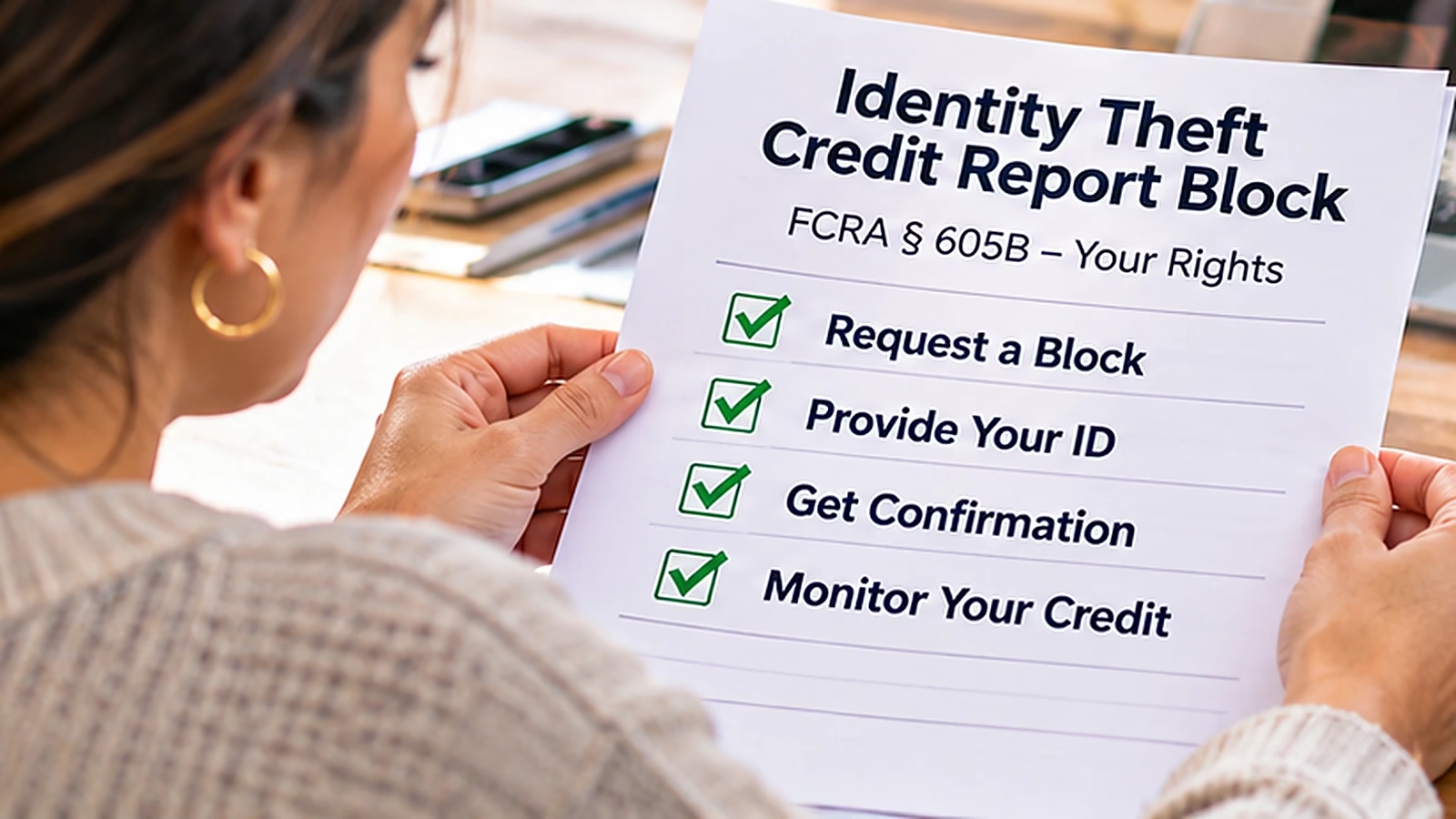
Collect your credit report with fraudulent items marked, government identification or other accepted proof, an FTC identity theft report, and a truthful signed statement that the transactions were not yours. Submit to each relevant bureau and keep complete copies.
Track the date each bureau receives a complete packet, confirm the block, and verify follow-up reports. Contact furnishers directly about fraudulent accounts. Consider credit freezes, password changes, and multi-factor authentication to reduce future misuse.
Frequently asked questions
Is a police report always required? An FTC identity theft report can often satisfy the identity theft report requirement, but special circumstances and additional agency requests should be checked. Does the four-day rule mean four calendar days? No, the statute says business days after receipt of required information.
Can you block a real debt you regret? No. Can a bureau reverse a block? Yes, in specified circumstances. Is a freeze the same as a block? No. Should you pay a company to submit the request? You can generally prepare and submit the documents yourself using free official resources.
Sources and editorial disclosure
Primary references: FTC Section 605B text, CFPB identity theft recovery, FTC sample letter, and Regulation V. Verify bureau procedures before submitting personal documents.
Meridian Pioneer Editorial Team. We publish independently researched U.S. consumer-finance explainers using primary legal and regulatory sources. This article is educational information, not individualized legal advice. Consult an attorney or legal aid provider about litigation or contested identity-theft claims.