
Published May 20, 2026 · By

Your credit score took a hit — a medical bill, a job loss, or just a rough stretch — and now you're wondering if you can get credit cards that actually work today, without waiting a week for a decision or 10 days for a card in the mail. You're not alone, and the short answer is: yes, you can.
In 2026, a growing number of issuers offer credit cards with instant approval decisions and virtual card numbers you can use within minutes of being approved. This guide covers everything you need — who qualifies, which cards are worth your time, what the rates look like, and how to get through the process fast.
Disclaimer: This article is for educational purposes only and does not constitute financial, legal, or tax advice. Eligibility, rates, terms, and lender availability vary based on your credit history, income, property value, age, and other individual factors. Always consult a qualified professional before making any financial decision.

What Are Credit Cards with Instant Approval and How Do They Work?
Credit cards with instant approval are products where the issuer makes a lending decision in seconds — not days — after you submit an online application. Once approved, many issuers send a virtual card number directly to your email or mobile app, which you can add to Apple Pay, Google Pay, or use for online purchases right away.
Here's how the process works: you fill out a short online form with your name, address, Social Security number, and monthly income. The issuer runs an automated credit check, evaluates your profile, and returns a decision — usually in under two minutes.
What most people don't realize is that "instant approval" and "instant use" aren't the same thing. Getting approved quickly is only half the equation; instant use means you can actually spend before your physical card arrives. Not every card offers both, so it matters which one you pick.
For applicants with bad credit, the two most common paths are secured credit cards — where a refundable deposit becomes your credit limit — and credit-builder cards, which pull from your own bank balance instead of extending new credit. Both options report to the major bureaus and are specifically designed for people rebuilding from the ground up.
5 Real Benefits of Credit Cards for Bad Credit with Instant Approval
1. Credit Cards That Build Your Score from Day One
Most secured and credit-builder cards report to all three major bureaus — Experian, Equifax, and TransUnion — so your positive payment history starts accumulating immediately. The sooner you begin, the sooner your score reflects the work you're putting in.
2. No Long Wait for a Physical Card
Traditional applications often take 7–10 business days to deliver a card by mail. With instant-use products, a virtual card number arrives within minutes of your approval. That's a meaningful difference when you have a real purchase to make today.
3. Lower Barrier to Entry Than Almost Anything Else
Many secured credit cards designed for bad credit require no minimum credit score. People with scores in the 400s or 500s — or with no credit history at all — can often qualify. Let's be real: very few financial products open the door that wide.
4. Built-In Spending Limits Help You Stay on Track
Because most bad-credit options start with limits between $200 and $500, there's a natural cap on how much you can put on the card. That guardrail makes it easier to practice responsible habits without the risk of running up a large balance.
5. A Clear Upgrade Path Without Reapplying
Many issuers automatically review your account after 6–12 months of consistent, on-time payments. If you qualify, they'll convert you to an unsecured card and return your deposit — no new application required. That's a concrete, measurable step toward better credit products.
Who Qualifies for Instant Approval Credit Cards with Bad Credit?
The short answer is: more people than you might expect, depending on the card type. Here's what most issuers actually look at when you apply.
Credit score: For secured credit cards, many issuers accept scores as low as 300 or will approve applicants with no credit history at all. OpenSky® Secured Visa® doesn't run a credit check at all. For unsecured bad-credit cards, you'll typically need at least a 550–580 score.
Income: Most issuers require some form of verifiable income — regular employment, freelance work, Social Security, disability benefits, and alimony all generally count. There's usually no stated income floor, but the issuer needs confidence you can cover the minimum monthly payment.
Age and residency: You must be at least 18 years old and a U.S. resident with a valid SSN or ITIN. Applications from non-residents or those without a valid taxpayer ID will not be processed.
Recent delinquencies or collections: These can complicate your application with some issuers, but they won't automatically disqualify you for cards that skip the credit check or specialize in bad-credit applicants.
Bankruptcy: A recent bankruptcy — especially within the past 12 months — may close the door on unsecured options. However, secured cards and credit-builder products specifically designed for post-bankruptcy consumers remain accessible.
Requirements and Documents
Most online applications for secured or bad-credit cards take under five minutes when you have these items ready. Preparing them in advance prevents delays that can break the instant-approval process.
- Government-issued photo ID (driver's license, state ID, or U.S. passport)
- Social Security Number (SSN) or Individual Taxpayer Identification Number (ITIN)
- Current U.S. residential address — most issuers do not accept P.O. boxes
- Proof of income: last 2 pay stubs, or 2 years of tax returns if self-employed, or a current benefits award letter
- Bank account details (routing and account number for funding the security deposit)
- Active email address — your virtual card number and login credentials arrive here immediately after approval
- Mobile phone number — some issuers require SMS verification as a security step
- Deposit funds: typically $200–$500 available in your checking or savings account
For secured card applications, the deposit is usually debited within 1–2 business days of approval. This amount is fully refundable when you close the account in good standing or earn an upgrade to an unsecured product.
Best Credit Cards for Bad Credit in 2026 — Comparison
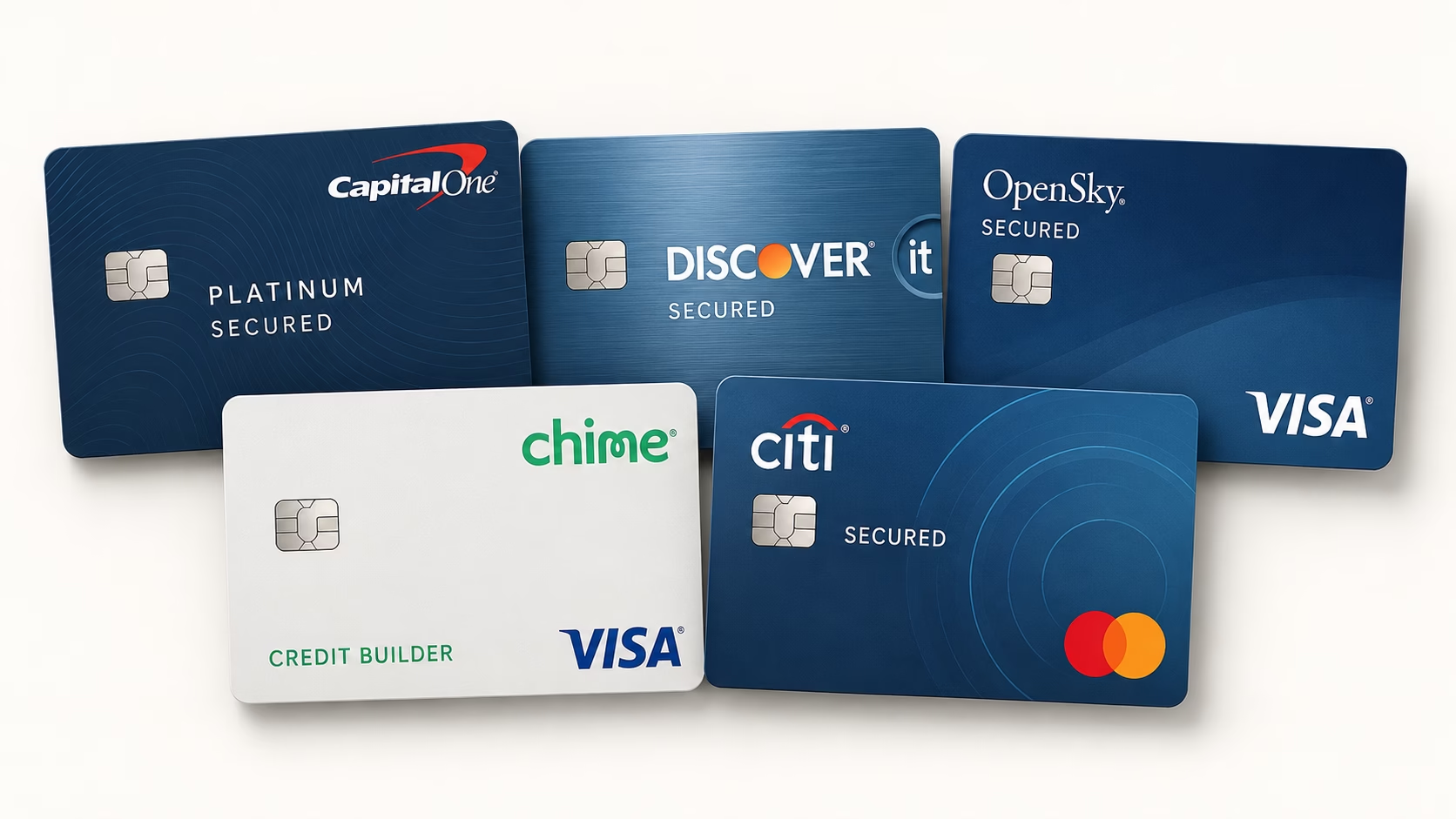
Here's a side-by-side look at the leading credit cards with instant approval for bad credit available to U.S. consumers in 2026. Use this table as a starting point, then read the notes below each card before you apply.
| Card / Issuer | APR Range | Credit Limit | Min. Credit Score | Instant Use |
|---|---|---|---|---|
| Capital One Platinum Secured | 29.99% variable | $200–$1,000 | No minimum | Yes — virtual card via app |
| Discover it® Secured | 28.24% variable | $200–$2,500 | ~580 recommended | Yes — via Discover app |
| OpenSky® Secured Visa® | 25.64% variable | $200–$3,000 | None (no credit check) | No — physical card only |
| Chime Credit Builder Visa® | 0% (no interest charges) | Up to Chime account balance | None (no credit check) | Yes — instant after signup |
| Citi® Secured Mastercard® | 28.24% variable | $200–$2,500 | ~580 recommended | No — physical card only |
Capital One Platinum Secured is one of the most accessible credit cards on the market today. You can qualify with limited or poor credit, and Capital One provides a virtual card number through its mobile app immediately after approval — a real advantage if instant use matters to you. After six months of on-time payments, Capital One automatically reviews your account for a higher credit line.
Discover it® Secured stands out because it earns cash back — 2% at gas stations and restaurants, 1% everywhere else — which is uncommon for a card in this category. Discover also matches every dollar of cash back earned in your first year. After seven months, Discover reviews your account to determine if you qualify to graduate to an unsecured card and get your deposit back.
OpenSky® Secured Visa® is the right call if you want to avoid a credit check entirely. There's no hard inquiry, meaning even applicants with very recent negative marks can get approved without further hurting their score. The trade-off: no virtual card, so you'll wait 7–10 days for the physical card to arrive by mail.
Chime Credit Builder Visa® operates differently from traditional credit cards. There's no interest because it functions like a secured charge card tied to your Chime Spending Account balance — you can only spend what you've moved into the account. It reports to all three bureaus, has no minimum deposit requirement, and is available almost instantly to existing Chime members. If you don't already have a Chime account, you'll need to open one first.
Citi® Secured Mastercard® is a reliable option from a major bank with no annual fee and a straightforward application. It's best suited for applicants with some existing credit history and a score close to or above 580 who prefer working with an established financial institution.
Rates, APR, and Card Terms — What You'll Actually Pay
As of May 2026, the Federal Reserve rate is 4.25–4.50% and the Prime Rate is 7.50%. Credit cards designed for bad credit carry APRs well above those benchmarks — typically ranging from 25% to 30% or higher — because issuers price for the added risk of lending to applicants with damaged credit histories.
Here's how APR actually affects your wallet: if you carry a $500 balance on a card with a 28% APR, you'll pay roughly $11.50 in interest per month when you don't pay in full. At 30% APR, that's about $12.50. The numbers compound quickly if you let a balance grow.
Several factors determine the specific rate you'll receive:
- Credit score: Lower scores typically mean higher rates. Many secured credit cards use a flat variable APR rather than a range, so your score may not change the number — but it affects whether you're approved at all.
- Income: A higher reported income signals stronger repayment ability, which can work in your favor on tiered-rate products.
- Card type: Secured cards usually carry fixed or lightly variable APRs. Unsecured bad-credit cards are more likely to use variable rates tied directly to the Prime Rate.
- Deposit size: With certain issuers, a larger security deposit may qualify you for a higher credit limit or slightly better terms.
What most people don't realize is that APR becomes irrelevant when you pay your full statement balance each month. Credit cards are effectively a zero-cost tool when paid in full — interest only applies to balances you carry past the due date. For rebuilding purposes, the strategy isn't to carry a balance; it's to make small, regular purchases you'd make anyway and pay the statement balance in full each billing cycle.
Always confirm whether your card includes a grace period (usually 21–25 days after the billing cycle closes). If you pay in full before the due date, you owe zero interest — no matter how high the stated APR looks on paper.
Tips to Get Approved Fast for Credit Cards with Bad Credit
- Pull your credit report before you apply. Get your free report at AnnualCreditReport.com. Check for errors — an incorrect late payment or wrong balance could be lowering your score for no reason. Dispute anything inaccurate directly with the bureau before applying.
- Match the card to your actual score band. Applying for a card aimed at good-credit consumers when your score is 510 wastes a hard inquiry and almost guarantees a denial. Apply only to products that explicitly advertise approval for bad credit or no credit check.
- Have your deposit funds ready in your account. If you're applying for a secured card, the issuer will debit your deposit within 1–2 days. Having insufficient funds in your account after approval stalls card activation — and sometimes cancels the application entirely.
- Report every income source. Freelance income, Social Security benefits, disability payments, alimony, and child support are all eligible income. Understating your income is one of the most common and avoidable reasons for a denial or a lower credit limit than you'd otherwise receive.
- Apply to one card at a time. Multiple hard inquiries in a short window signal desperation to issuers and can lower your score by 10–15 points cumulatively. Research your options, pick your strongest match, and apply to one product first.
- Use a current, active email address. Your virtual card number is sent by email immediately after approval. Using an outdated address means you miss that window and have to wait for the physical card.
- Complete the application carefully and accurately. Name, address, or SSN mismatches flag the application for manual review — and manual review ends instant approval. Double-check every field before you submit.
- Use a pre-qualification tool when available. Capital One and Discover both offer soft-inquiry pre-qualification checks that show your approval odds without affecting your credit score. Use them to narrow your choices before committing to a formal application.
Frequently Asked Questions
Can I get credit cards with no credit check?
Yes. OpenSky® Secured Visa® and Chime Credit Builder Visa® are two well-known examples that approve applicants without running a hard credit inquiry at all. These products work because your deposit or linked bank balance protects the issuer — making your credit history largely irrelevant to the decision. The trade-off is that cards with no credit check typically don't offer instant virtual card access; you'll wait for a physical card in the mail. For more on your rights and options as a consumer, the FTC's consumer finance guide is a solid independent resource.
What credit score do I really need?
For secured credit cards built for bad credit, you can often qualify with a score as low as 300 — or with no score at all. For unsecured bad-credit cards, most issuers prefer at least a 550–580. If your goal is instant use via a virtual card, Capital One and Discover are your best bets and both are accessible to scores in the mid-500s to low-600s range. If your score is below 500, a no-credit-check secured card is the most reliable starting point.
How fast can I get and use my card?
With the right issuer, you can be approved and using a virtual card number within minutes. Capital One and Chime are both known for providing instant virtual card access through their mobile apps immediately after approval. Physical cards typically arrive by mail within 7–10 business days regardless of issuer. If speed is a priority, focus exclusively on issuers — like Capital One and Discover — that explicitly advertise virtual card issuance upon approval.
Will applying hurt my credit score?
It depends on the type of inquiry. Pre-qualification tools from Capital One and Discover use a soft pull, which has zero impact on your score — use those freely. The formal application triggers a hard inquiry, which can lower your score by 3–5 points and stays on your report for two years (though the impact fades significantly after a few months). Here's what works in your favor: if you're approved and start using the card responsibly, the long-term credit-building benefit outweighs that small, temporary dip within a few billing cycles.
Can I get approved after bankruptcy?
Yes — timing and card type are what matter most. Most major issuers won't approve unsecured credit cards during an open bankruptcy filing or within 1–2 years of a Chapter 7 discharge. However, secured cards — particularly those with no credit check — are frequently available even shortly after bankruptcy. OpenSky and Chime are both frequently cited by consumers who were approved in the post-bankruptcy window. Start with a secured product, use it consistently, and within 12–18 months you'll have meaningfully more options available.
What happens if I miss a payment?
A missed payment triggers a late fee — typically $25–$40 depending on the issuer. If the payment goes more than 30 days past due, the issuer reports it to the credit bureaus, which can significantly damage a score you've been working hard to rebuild. Some issuers also apply a penalty APR, raising your rate to 29.99% or higher permanently. Here's what works to avoid this: set up autopay for at least the minimum payment amount so you never miss a due date. If you know you're going to be late, call your issuer before the due date — many will offer a one-time courtesy waiver for first-time late payments, especially if you ask proactively.
The Bottom Line
Bad credit doesn't close the door on credit cards in 2026 — it just points you toward products built specifically for people in your situation. Secured options from Capital One, Discover, and Chime offer real approval decisions, transparent terms, and bureau reporting that actually moves your score over time.
The most effective approach is simple: choose the right card for where your credit stands today, use it for small purchases you'd make anyway, and pay the full statement balance each month. Consistent on-time payments over 6–12 months is what genuinely changes your credit profile — and opens the door to better rates and products down the road.
If you're ready to take the next step, explore our full credit cards resource library at Meridian Pioneer for more comparisons and guides. If managing existing debt is your immediate priority before applying for new credit, our debt relief section covers practical options for getting balances under control first.