
Published May 20, 2026 · By

You applied for a credit card — and got denied. Again. A 500 credit score feels like a locked door, and most card issuers seem perfectly happy to keep it that way. But here's what most people don't realize: a 500 score doesn't disqualify you from getting a credit card. It just means you need to know which doors are actually open and how to walk through them.
This guide covers the real options available to you right now in 2026 — including secured cards, no-credit-check cards, and unsecured products designed for scores in the 480–580 range. You'll also learn what lenders look beyond your score, what documents to have ready, and how to use your new credit card to climb out of the "poor credit" bucket for good.
Disclaimer: This article is for educational purposes only and does not constitute financial, legal, or tax advice. Eligibility, rates, terms, and lender availability vary based on your credit history, income, property value, age, and other individual factors. Always consult a qualified professional before making any financial decision.
What Is a Credit Card and How Does It Work When Your Score Is 500?
A credit card is a revolving line of credit issued by a bank or financial institution that lets you borrow money up to a preset limit and repay it monthly — either in full or over time with interest. When you use it responsibly, it reports your payment behavior to all three major credit bureaus every single month.
That reporting cycle is why a credit card is one of the most effective tools available for rebuilding damaged credit. No savings account, prepaid debit card, or checking account can do that for your score.
For someone with a 500 credit score, options fall into two main buckets:
Secured credit cards: You put down a refundable cash deposit — typically $200 to $500 — that becomes your credit limit. Because the issuer holds your money as collateral, approval is much easier. These are the most accessible entry point for anyone in the poor-to-fair credit range.
Unsecured cards for bad credit: No deposit required. These cards are designed for applicants with damaged or thin credit files, but they typically come with higher APRs, lower credit limits, and annual fees. Approval is harder than secured cards, but not impossible at 500.
Here's a concrete example: you're approved for a secured credit card with a $300 deposit and a $300 limit. You use it for gas each month ($60–$80), then pay the full balance before the due date. After six months of that pattern, your on-time payment history is building steadily, your utilization stays low, and your score starts climbing. That's the whole strategy.
On the FICO scale, 500 falls in the "poor" range (300–579). But most secured card issuers don't enforce a hard minimum score — and some don't pull your credit at all. The score is one signal among many, and it's not always the deciding one.
5 Real Benefits of Getting a Credit Card with a 500 Score
1. A Credit Card Reports Your Payments to All Three Bureaus
Every on-time payment gets sent to Equifax, Experian, and TransUnion — the three agencies that calculate your FICO score. Payment history is the single largest factor in your score, making up 35% of your total. Even one secured credit card used consistently can move your score by 30–60 points within six to twelve months.
2. You Establish the Credit Mix Lenders Want to See
FICO rewards having different types of credit — installment loans, mortgages, and revolving credit. A credit card fills the revolving credit slot, which many people with poor scores are missing entirely. Adding it to your credit profile signals to future lenders that you can manage different kinds of debt.
3. You Build a Verifiable Track Record for Future Applications
When you eventually apply for a car loan, a mortgage, or a better credit card, lenders want to see evidence of responsible borrowing — not just a score. Twelve months of clean credit card history is often the difference between approval and denial on those bigger products.
4. You Get Access to a Small Emergency Buffer
Let's be real — a debit card tied to a low bank balance doesn't give you much room when something unexpected happens. A secured credit card with even a $300 limit creates a small but meaningful cushion for genuine emergencies, without having to resort to payday loans or other costly options.
5. You Have a Clear Path to Upgrade Later
Here's what works in the long run: most major issuers — Capital One and Discover in particular — automatically review your account after six to twelve months of responsible use. If you qualify, they upgrade you to an unsecured card and return your full deposit. You can also use your improved score to apply for cards with rewards, lower APRs, and higher limits within a year or two.

Who Qualifies for a Credit Card with a 500 Credit Score?
More people than you'd expect. Here's what issuers actually look at when your score is in the 500 range — and where flexibility exists.
Credit score: For secured cards, there is effectively no minimum. OpenSky's Secured Visa skips the credit pull entirely — your score is irrelevant to the approval decision. For unsecured bad-credit cards like Credit One Bank and Mission Lane, scores between 480–580 are generally considered, though recent negative marks can affect the outcome.
Income: Issuers want to confirm you can repay what you spend. There's no universal income floor, but most expect at least $12,000–$18,000 in annual income. You can include freelance earnings, side income, or a spouse's or partner's income if you have reasonable access to it. Self-employed applicants should use their gross annual income from their most recent tax return.
Debt-to-income ratio (DTI): If your existing monthly debt payments consume most of your income, that raises a red flag — even for secured cards. A DTI below 40% puts you in a more favorable position when applying.
Recent derogatory marks: Collections, charge-offs, and even bankruptcy don't automatically disqualify you — especially for secured cards. However, very recent negative marks (within the past three to six months) can trigger denials even on entry-level products. If your report has fresh negatives, a brief waiting period before applying may improve your outcome.
Basic eligibility: You must be at least 18 years old, a U.S. resident, and have a valid Social Security Number or ITIN.
Requirements and Documents for a Credit Card Application
Having everything ready before you apply prevents delays and avoids small mistakes that can trigger unnecessary denials. Here's what most issuers ask for:
- Government-issued photo ID — driver's license, state ID, or U.S. passport
- Social Security Number (SSN) or Individual Taxpayer Identification Number (ITIN)
- Proof of income — last 2 pay stubs (if employed), most recent W-2, or 2 years of federal tax returns (if self-employed or 1099 contractor)
- Proof of current U.S. address — utility bill, bank statement, or signed lease agreement dated within the last 60 days
- Active checking or savings account — required to fund the security deposit via ACH transfer or debit card for secured cards
- Security deposit funds ready — typically $200–$500; have it available and liquid in your bank account before starting the application
- Email address and phone number — used for identity verification, account alerts, and card delivery updates
Before you apply, pull your free credit reports at AnnualCreditReport.com and review each one carefully. Incorrect late payments, duplicate accounts, or outdated collections that don't belong to you can be disputed and removed — sometimes improving your score by 15–30 points before you even submit an application.
Best Credit Card Issuers for a 500 Score in 2026 — Comparison
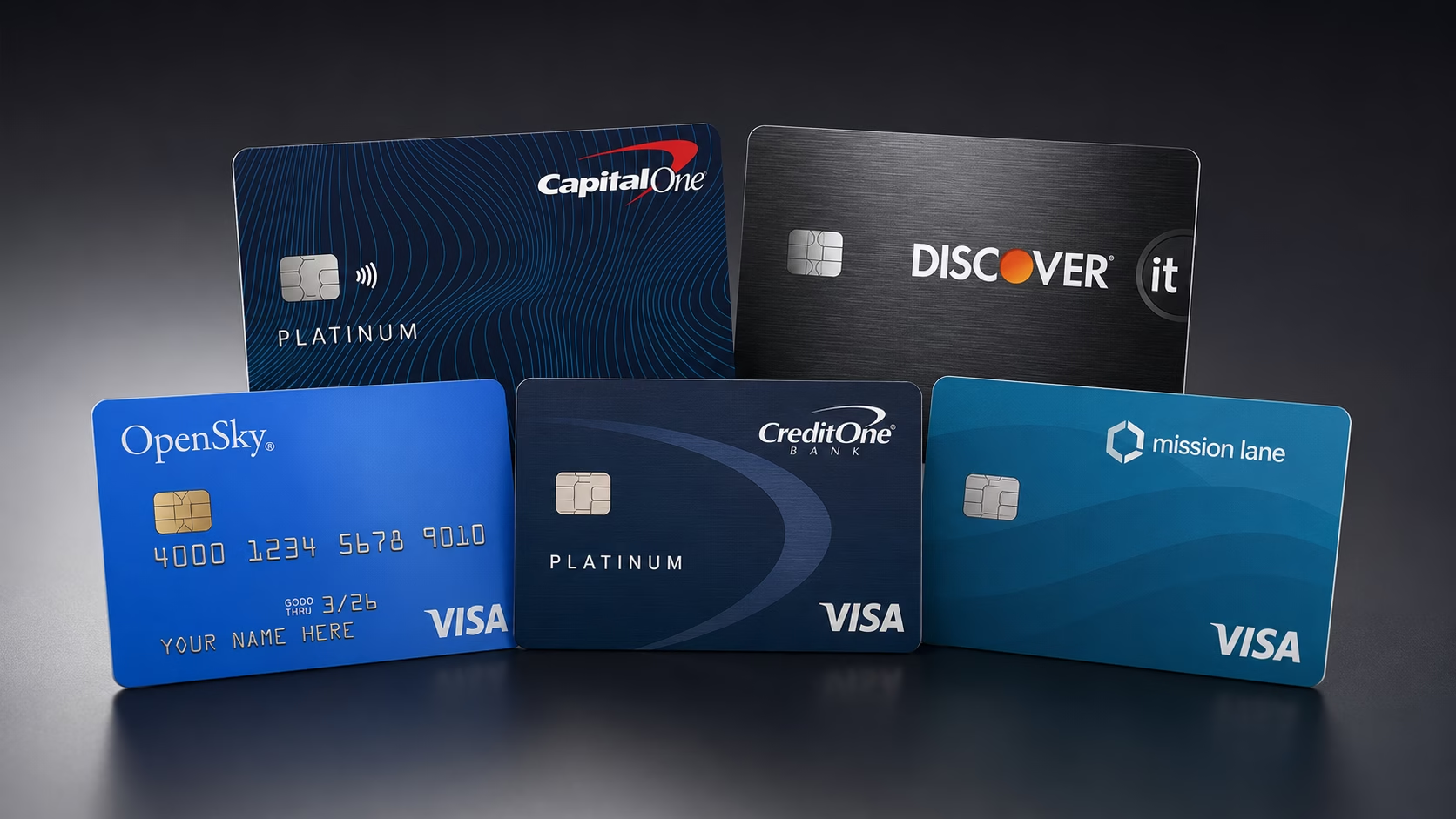
The five issuers below consistently approve applicants in the 480–580 range. We've focused on real terms, not promotional estimates.
| Issuer | APR Range | Credit Limit | Min. Credit Score | Annual Fee |
|---|---|---|---|---|
| Capital One Platinum Secured | 29.99% variable | $200–$1,000 | None (secured) | $0 |
| Discover it® Secured | 28.24% variable | $200–$2,500 | None (secured) | $0 |
| OpenSky® Secured Visa® | 24.64% fixed | $200–$3,000 | No credit check | $35/yr |
| Credit One Bank® Platinum Visa® | 29.74% variable | $300–$2,000 | ~480 | $75–$99/yr |
| Mission Lane Visa® | 26.99%–33.99% variable | $300–$1,500 | ~500 | $0–$59/yr |
Capital One Platinum Secured is one of the most beginner-friendly options on the market. There's no annual fee, and after making six on-time monthly payments, Capital One will automatically review your account for a credit limit increase — sometimes without requiring an additional deposit. The path from secured to unsecured is well-established here.
Discover it® Secured is the standout of the group because it actually rewards you while you rebuild. You'll earn 2% cash back at gas stations and restaurants (up to $1,000 per quarter combined) and 1% on all other purchases. Discover also matches every dollar of cash back you earn in your first year. After seven months of responsible use, Discover begins reviewing accounts for automatic upgrade to an unsecured card — one of the clearest graduation paths available in this category.
OpenSky® Secured Visa® is the right call if your credit situation is especially difficult. There's no credit check — they don't pull your report at all. Bankruptcies, multiple collections, or a completely blank credit file won't prevent approval. The $35 annual fee is reasonable given that guarantee. OpenSky also reports to all three credit bureaus, so it still does the job of building your credit history month after month.
Credit One Bank® Platinum Visa® is an unsecured option — no deposit required — which makes it attractive when you don't want to tie up cash. The trade-off is cost: the annual fee starts at $75 in year one and rises to $99 thereafter. Read the full terms before applying, as Credit One also charges other fees that can add up quickly if you're not paying close attention.
Mission Lane Visa® is a newer unsecured card gaining traction among applicants with fair-to-poor credit. APR and annual fee vary by applicant — some users see $0 in annual fees, others pay up to $59. Approval decisions come back in seconds, and the application process is straightforward and fully online.

Rates, APR, and Credit Card Terms Explained for 2026
With the Prime Rate at 7.50%, even the most competitive credit cards for bad credit are sitting in the high-20s to low-30s APR range. That's the market reality right now, and it's the main reason carrying a balance on a bad-credit card is so costly.
Here's how APR actually works on your statement: your annual rate is divided by 365 to get a daily periodic rate. If you carry a $400 balance at 29.99% APR, your daily interest charge is roughly $0.33. Leave that balance untouched for a month and you've added about $10 in interest. Over a year, that same $400 balance generates roughly $120 in interest charges alone.
What determines the specific APR you'll get?
Your credit score at the time of application. The difference between a 500 and a 560 score can result in meaningfully different APR offers, even on the same card. Every point counts when you're in the poor-to-fair range.
Your income and debt obligations. A higher income relative to your existing monthly debt — a lower DTI — signals lower default risk. Issuers factor this in when setting your rate, even on cards that don't advertise tiered pricing.
Fixed vs. variable rate structure. OpenSky is one of the few bad-credit cards offering a fixed APR (24.64%). Fixed means the rate won't change when the Fed adjusts rates. Variable cards — Capital One, Discover, Credit One, Mission Lane — will fluctuate with the Prime Rate, for better or worse.
The most important strategy for a 500 score cardholder? Pay your full statement balance every month, without exception. If you do that, the APR is completely irrelevant — you'll never pay a single dollar of interest. Treat the card as a monthly habit for building credit, not as a borrowing tool, and the high rates won't cost you anything.
The FTC's consumer credit guide is also worth bookmarking — it explains your rights as a borrower and what lenders can and can't do when evaluating your application.
Tips to Get Approved for a Credit Card Fast
- Pull your credit reports before applying. Get all three free reports at AnnualCreditReport.com and dispute any errors — incorrect late payments, accounts that don't belong to you, or outdated collections can shave points off your score unnecessarily. Fix those before submitting a single application.
- Apply for cards that match your actual score range. Applying for a rewards card designed for 700+ scores when you're at 500 burns a hard inquiry and nearly guarantees a denial. Stick to secured cards and bad-credit unsecured products that explicitly target the 480–580 range.
- Use pre-qualification tools before formally applying. Capital One and Discover both offer pre-qualification pages that run only a soft inquiry — your credit score won't budge. You'll get a realistic read on your odds before committing to a hard pull.
- Space out your applications. Every formal application triggers a hard inquiry, which can drop your score by 2–5 points. If you're rejected, wait at least 60–90 days before applying elsewhere. Multiple applications in a short window compound the score impact and signal desperation to future lenders.
- Have your deposit funds liquid and ready. For secured cards, approval is fast — but you'll need to fund the deposit immediately. Have at least $200–$300 sitting in your checking account before you start the process so you don't lose your approval window.
- Pay down existing balances before applying. If you already carry high balances on other accounts, your credit utilization ratio is working against you. Paying down even one maxed-out card before applying can lift your score enough to improve your terms or open up more options.
- Report all eligible income on your application. Include side gig earnings, freelance income, and any household income you have reasonable access to. A higher reported income makes you look like a stronger applicant, even with a lower score.
- Consider a credit-builder loan as a first step. If you've been denied multiple times, a credit-builder loan from a credit union or a service like Self can raise your score by 20–40 points within six months — making your next credit card application far more likely to succeed. Our personal loan guides cover how credit-builder products work and which ones are worth considering.
Frequently Asked Questions
Can I get a credit card with no credit check?
Yes — the OpenSky® Secured Visa® is the most widely known option that skips the credit check entirely. Some credit union secured cards and certain retail store credit accounts also bypass the hard inquiry. These no-check cards typically come with an annual fee and a lower starting credit limit, but they're a legitimate path for anyone whose credit history is especially troubled, recently discharged from bankruptcy, or completely blank. The short answer is: no-check cards exist, they work, and they still report to the credit bureaus — so they'll build your credit just the same.
What credit score do I really need to get a credit card?
For secured credit cards, the honest answer is almost any score — including scores in the 400s. Issuers hold your deposit as collateral, so the score matters much less. For unsecured bad-credit cards, most issuers want to see at least 480–500. What they care about almost as much as the number is the trend: is your score stable or improving? Are there very recent derogatory marks? A 500 score with no new negatives in the last six months is a stronger application than a 520 with a fresh collections account.
How fast can I get a credit card after applying?
Most major issuers — Capital One, Discover, Mission Lane — deliver instant approval decisions online. You'll typically know within 60 seconds. Once approved, the physical card arrives by mail within 7–10 business days. Some issuers provide a virtual card number immediately after approval, which you can use right away for online purchases. For secured cards, keep in mind that your card won't be activated until your deposit clears, which usually takes 2–5 business days via ACH bank transfer.
Will applying for a credit card hurt my credit score?
Yes — but only slightly, and only temporarily. A hard inquiry typically drops your score by 2–5 points, and that effect fades over twelve months. It disappears from your report entirely after two years. In nearly every case, the credit-building benefit of opening a new account and using it responsibly far outweighs the small short-term dip from the inquiry. To minimize the hit before you're ready to commit, use pre-qualification tools that only run soft inquiries — they won't move your score at all.
Can I get approved for a credit card after bankruptcy?
Yes, and often sooner than people expect. Secured credit cards are frequently available immediately after a bankruptcy discharge, since the deposit eliminates most of the lender's risk. OpenSky and Capital One are both known to approve applicants with recent bankruptcies on their record. Chapter 7 stays on your credit report for ten years, but issuers weigh your current income, your deposit amount, and your behavior since the discharge more heavily than the bankruptcy itself — especially once you're one to two years post-discharge.
What happens if I miss a payment on my credit card?
A few things happen in sequence, and they escalate. First, you'll be charged a late fee — typically $25–$40. Second, if the payment is 30 or more days late, the issuer reports it to the credit bureaus, which can drop your score by 50–100 points in a single month. Third, your APR may jump to a penalty rate, sometimes as high as 29.99%–34.99%, making it harder to pay down your balance going forward. If you realize you've missed a payment, call your issuer immediately — many will waive the fee for a first-time miss if you ask. The simplest prevention: set up autopay for at least the minimum payment so late fees and bureau reports become a non-issue.
The Bottom Line: Your 500 Score Is a Starting Point, Not a Dead End
Getting approved for a credit card with a 500 credit score is absolutely possible — it just requires targeting the right products and having a clear plan for how you'll use the card once you have it. Secured cards from Capital One and Discover are two of the strongest starting points: no annual fee, clear upgrade paths, and issuers that actually report your progress to all three credit bureaus every month.
The strategy is simple: keep your utilization low, pay your full balance every month, and give it six to twelve months. You'll likely be surprised by how much your score can move from that one change alone. When you're ready to explore more options — whether a rewards card, a personal loan, or something else — browse our full credit card guides at Meridian Pioneer for unbiased, up-to-date comparisons to help you make the right call at each step.