
Updated October 21, 2026 · Originally published October 20, 2026 · By

Quick answer: The home vs public EV charging cost comparison depends on more than the price printed on a charging screen. Home charging usually involves your residential electricity tariff, charging losses and possibly installation costs. Public charging may include a higher energy rate, time-based billing, session fees, idle penalties or parking charges. Compare the total cost to add a useful amount of driving range, not simply the price per kilowatt-hour displayed.
The U.S. Department of Energy's Alternative Fuels Data Center (AFDC) notes that public charging normally costs more than charging at home, especially at DC fast chargers, but pricing models vary by operator and location. The economically best arrangement depends on your electricity plan, mileage, access to equipment and frequency of highway trips.
The difference between Level 1, Level 2 and DC fast charging
Level 1 charging uses standard household electrical service and generally adds range slowly. Level 2 charging uses higher-power equipment and is common in homes, workplaces and public facilities. DC fast charging provides faster charging at compatible public locations, but speed varies with battery temperature, vehicle charging capabilities and battery state of charge.
Faster charging is not automatically cheaper. A commuter who can recharge overnight may have no practical need to pay a premium for DC fast charging every week. Renters or drivers without reliable parking may find public charging a necessary operating cost even when home equipment would be less expensive in theory.
Use AFDC's public charging guide to distinguish charger types and typical use cases.
Home vs public EV charging cost: the right formula
Start with the energy the EV needs in its battery: miles driven ÷ miles per kWh. Then adjust for the energy lost between the wall and battery when evaluating a home electricity bill: battery kWh ÷ charging efficiency. Multiply by the applicable home energy price per kWh, adding relevant variable tariff charges and considering a time-of-use plan.
For public stations billing by kWh, multiply the kWh billed by the posted price and add session, parking or idle charges. When stations bill by time, charging speed and tapering make cost less predictable. A flat session charge also changes the economics of a small top-up.
Do not mix 'energy delivered to the vehicle' with 'energy drawn from the grid' without adjusting for charging losses and the specific meter or billing method.
Home vs public EV charging cost: a 200-mile example
Consider a hypothetical EV averaging 3.5 miles per kWh over a 200-mile driving period. It needs approximately 57.14 kWh stored in its battery for that travel. If residential AC charging operates at an assumed 90% wall-to-battery efficiency, the grid energy used is approximately 63.49 kWh. At a hypothetical marginal residential price of $0.16/kWh, the charging energy costs roughly $10.16.
For an intentionally simplified public comparison, assume the station bills $0.45 per delivered kWh and the vehicle receives 57.14 billed kWh. The energy-only public cost would be $25.71, before any separate charges. These home vs public EV charging cost figures do not reflect actual local offers, public charger losses, route elevation, weather or charging curtailments.
| 200-mile illustration | Home AC | Public billed kWh |
|---|---|---|
| Energy basis | 63.49 grid kWh | 57.14 billed kWh |
| Assumed unit rate | $0.16/kWh | $0.45/kWh |
| Energy-only cost | $10.16 | $25.71 |
Add charger, electrical work and utility charges
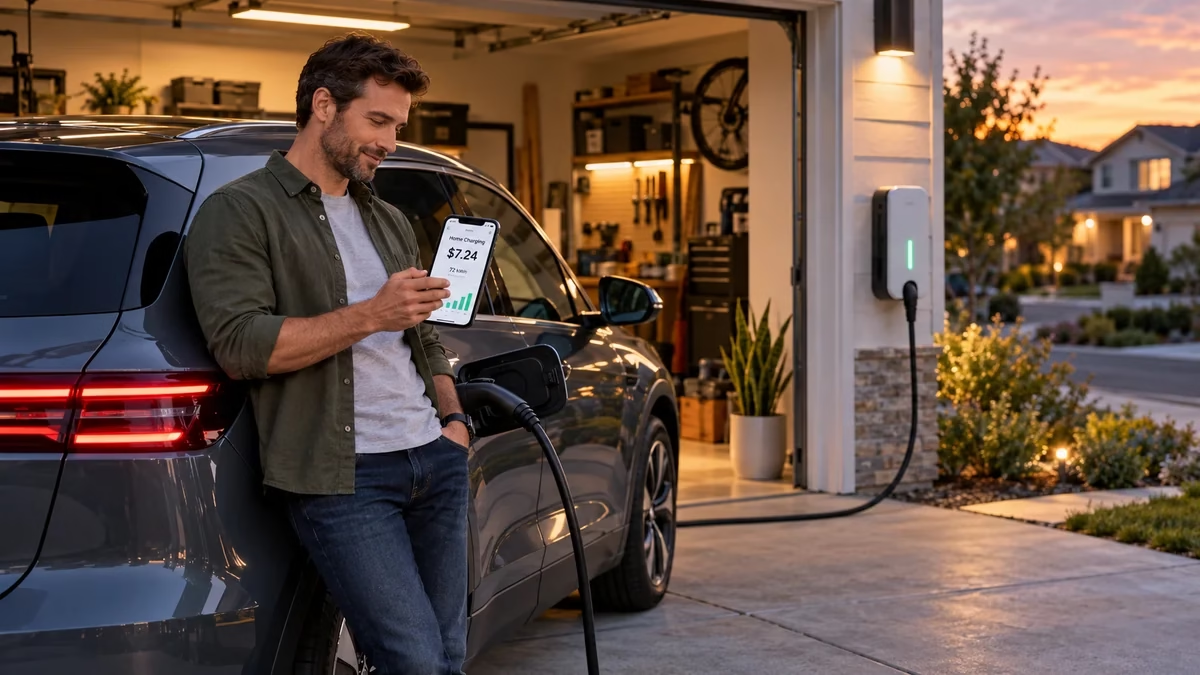
The home vs public EV charging cost comparison must include upfront costs: home charging is not completely 'free after installation'. Equipment, permits, labor, necessary electrical upgrades and potential utility fixed charges can raise total ownership cost. Some homes already have an appropriately located outlet and can use a manufacturer-approved portable charging solution; others require licensed electrical evaluation and significant work.
Ask an electrician for a written estimate before buying a charger. Have the electrical professional confirm panel capacity, circuit, installation requirements and local permits. Avoid unsupported DIY modifications or extension-cord arrangements. Review whether utility plans, rebates or demand-related charges affect your marginal energy price.
How to calculate installation break-even
For a home vs public EV charging cost break-even example, suppose a homeowner pays an incremental $1,200 to install a dedicated charging arrangement. If using it instead of routine public charging saves $15 per charging session, 80 comparable sessions would be required to offset that original expenditure ($1,200 ÷ $15), ignoring financing, maintenance and the time value of money.
At two sessions per week, that simple break-even period would be approximately 40 weeks. But only count sessions that actually replace paid public charging. If the owner would have used a no-cost workplace charger, or could use an existing outlet, the correct comparison changes. Home chargers may also influence convenience or property use in ways that are hard to assign a cash value.
Additional costs on public charging networks
For a home vs public EV charging cost estimate, review the app or charger screen for per-kWh prices, connection charges, time-based rates, parking fees, idle fees and any membership discounts. Operators may charge different prices by location, time and subscription. Public stations can become expensive when the EV remains connected after charging is complete, particularly when idle penalties apply.
Battery temperature and charging taper can extend session duration. If the charger bills by time, a slow session may cost more per added mile than anticipated. Public Level 2 chargers may also require parking purchases or facility admission. Build these expenses into a trip budget.
Seven-step checklist for deciding how to charge
- Identify your actual electric utility tariff and off-peak options.
- Estimate annual mileage and your car's observed miles per kWh.
- Check whether reliable, legal home charging is possible.
- Get itemized installation estimates, including permits and electrical upgrades.
- Record real public charger rates where you routinely drive.
- Calculate cost per 100 miles using matching energy assumptions and all fees.
- Compare flexibility, reliability and time requirements as well as dollars.
For road trips, plan charger alternatives and arrival state of charge. A temporarily cheaper but unreliable charger is not necessarily the practical best option.
Start with the actual marginal electricity price on your bill
Home EV charging costs should be based on what an additional kilowatt-hour of electricity costs your household, not necessarily the single average price displayed on a utility bill. Residential tariffs may have separate supply and delivery components, tiered consumption rates, time-of-use pricing, taxes, and fixed customer charges. If the household already pays a fixed monthly connection charge regardless of EV charging, assigning that entire charge to the car would distort the marginal calculation. On the other hand, if charging increases demand charges or pushes consumption into a more expensive tariff tier, ignoring that incremental cost understates the expense.
Read your utility's latest tariff schedule and any EV-specific time-of-use rules. A lower off-peak rate can change the result, but the exact hours, eligibility requirements and seasonal prices vary by utility. Some utility incentives require a compatible charger or separate metering. The U.S. Department of Energy's Alternative Fuels Data Center advises EV consumers to consider utility rates, charging location and equipment costs. The price used for the calculation should reflect the billing arrangement that actually applies, not a national average presented as a personal quote.
For a hypothetical example, suppose your household pays an incremental all-in energy rate of $0.18 per kWh during the hours when the vehicle charges. If the vehicle needs 30 kWh delivered to its battery and the charging process is 90% efficient, the wall must supply approximately 33.33 kWh. At $0.18 per kWh, that session costs about $6.00, not the $5.40 obtained by multiplying 30 kWh directly by the wall electricity rate. Charging efficiency in this example is an assumption, not a universal constant for all vehicles, temperatures or charger types.
Use a comparable cost-per-mile formula
Drivers compare energy consumption in different units: vehicle efficiency may be expressed as miles per kWh or kWh per 100 miles, while utilities bill the home in kWh and some charging networks bill per minute or session. Put both charging options on the same footing by calculating the cost to travel a fixed number of miles. If a vehicle consumes 30 kWh from its battery over 100 miles, its assumed traction-energy use is 0.30 kWh per mile. With an illustrative 90% AC charging efficiency, home electricity drawn becomes 0.30 ÷ 0.90, or about 0.333 kWh per mile. At $0.18 per kWh, the energy portion of home charging is about 6 cents per mile.
For comparison, suppose a public charging session effectively costs $0.42 for each kWh billed to the driver and 0.30 billed kWh is needed per mile under the assumed measurement convention. That produces approximately 12.6 cents per mile, before taxes, parking, idle fees or membership charges. In reality, the energy delivered and billed by the public charger, the vehicle's charging efficiency and the battery's energy consumption may not line up exactly. Confirm where each meter measures energy and use the correct conversion instead of applying the same charging-loss factor twice.
These numbers are purely illustrative. Public fast-charging prices, utility rates and charging losses are location-specific and change over time. For an accurate comparison, use your own vehicle's consumption over several representative trips and billing data from the stations you would actually visit. Consider winter heating or cooling loads, highway speeds and battery preconditioning, which can change real-world efficiency.
A worked example of home charger installation payback
The economic question is how much public charging a home setup actually replaces. Imagine a homeowner expects to spend $1,800 out of pocket on charging equipment and professional electrical work after any applicable incentives. Suppose charging at home costs $0.25 less per delivered kWh than the specific public sessions it would replace, under a consistent accounting for electricity delivered and losses. If the driver reliably shifts 240 kWh of charging per month to the home, the hypothetical monthly savings are $60: 240 × $0.25. The simple payback is therefore 30 months: $1,800 ÷ $60.
That result assumes the 240 kWh would otherwise have been purchased at the more expensive public station, and that the price gap and monthly use remain stable. If the owner would otherwise charge for free at work, drives only seasonally, or already has a usable home outlet that meets their needs, the avoided expense could be much smaller. If electrical panel improvements are necessary, the installation cost can increase considerably. The 30-month estimate excludes the time value of money, maintenance, changes in utility prices and any impact on property value.
Ask a qualified electrician for a written assessment and itemized quote, including permits, circuit requirements, equipment placement, any service upgrade and local inspection needs. Do not assume that every home requires an expensive Level 2 installation: some driving patterns can be served by a safe, suitable Level 1 arrangement where permitted by vehicle, outlet and electrical installation conditions. The U.S. Department of Energy's charging overview outlines how Level 1, Level 2 and DC fast charging serve different needs.
Compare options for renters, apartments and shared parking
Not every EV owner can install a dedicated charger. Renters may need written landlord permission, and condominium associations or shared-parking operators can impose practical access and electrical requirements. Some locations provide shared charging with separate parking and session fees. Before purchasing an EV or committing to a lease, find out whether overnight charging is accessible where you actually park, who controls the charger, whether users need an account, and how pricing may change.
Workplace charging may reduce costs but should not be treated as guaranteed unless the employer confirms capacity, access hours and terms. Public Level 2 chargers can be economical where parking time overlaps with errands or work, while DC fast charging can be valuable on trips or when time matters. But the fastest charger is not always the cheapest or most convenient. Charging speed also depends on the vehicle, battery temperature and state of charge; a charger advertising a high maximum power does not mean every vehicle will receive that rate throughout a session.
When planning a routine based on public charging, check connector and payment compatibility, availability, expected waiting times, possible parking restrictions and alternatives if a station is unavailable. If pricing is per minute, a slower-than-expected charging session can change the economics. Access reliability and the time spent detouring or waiting can make a nominally cheaper station less attractive than the simple energy-cost estimate suggests.
A seven-step EV charging comparison worksheet
- Measure realistic energy use: record miles driven and the vehicle's observed kWh consumption for those trips.
- Check utility tariffs: identify incremental home electricity costs and any off-peak periods or extra charges.
- Estimate charging losses consistently: avoid comparing battery energy on one side with wall or station-meter energy on the other.
- Collect local public prices: include session, parking, idle, tax and membership charges where applicable.
- Get a home installation quote: consider permits, electrical upgrades, equipment and eligibility for real incentives.
- Calculate displaced public charging: only count sessions you would genuinely avoid by charging at home.
- Stress-test convenience and flexibility: consider access, travel, charge times, reliability and changes in monthly driving.
Charging cost comparisons are most helpful when their assumptions are explicit and the cost per mile or month is tied to the user's real pattern. An EV owner who mostly charges overnight at home may reach a different conclusion from an apartment resident reliant on public fast chargers. There is no single nationwide price that captures every combination of vehicle, utility, charging location and installation expense.
Frequently asked questions
Is charging an EV at home always cheaper?
Not always. Local electricity rates, workplace charging, memberships, fees and installation costs can change the comparison.
Do I need a dedicated Level 2 charger at home?
Not necessarily. It depends on miles driven, available electrical service, vehicle compatibility and charging time needs.
Why is a DC fast charger expensive?
Pricing reflects network equipment, site electricity arrangements, service costs and operator decisions. Actual rates vary.
Are public charging prices always quoted per kWh?
No. Some stations charge per minute, per session or using combinations of methods, subject to local rules.
How do I avoid misleading charging comparisons?
Compare cost per distance traveled with consistent efficiency and loss assumptions, then include added fees.
Bottom line
A reliable home vs public EV charging cost comparison uses the same driving distance, realistic charging losses, actual electricity rates and all session fees. If you need new home equipment, include installation costs and calculate how many paid public sessions it would genuinely replace. Check your utility tariff and local charging prices before deciding; the illustrative rates above are not current offers.
Related Meridian Pioneer guides
Sources and editorial notes
Primary U.S. government resources reviewed October 20, 2026. Numeric illustrations are hypothetical, not current energy quotes, vehicle offers or guarantees. This is general educational content.