
Published May 24, 2026 · By

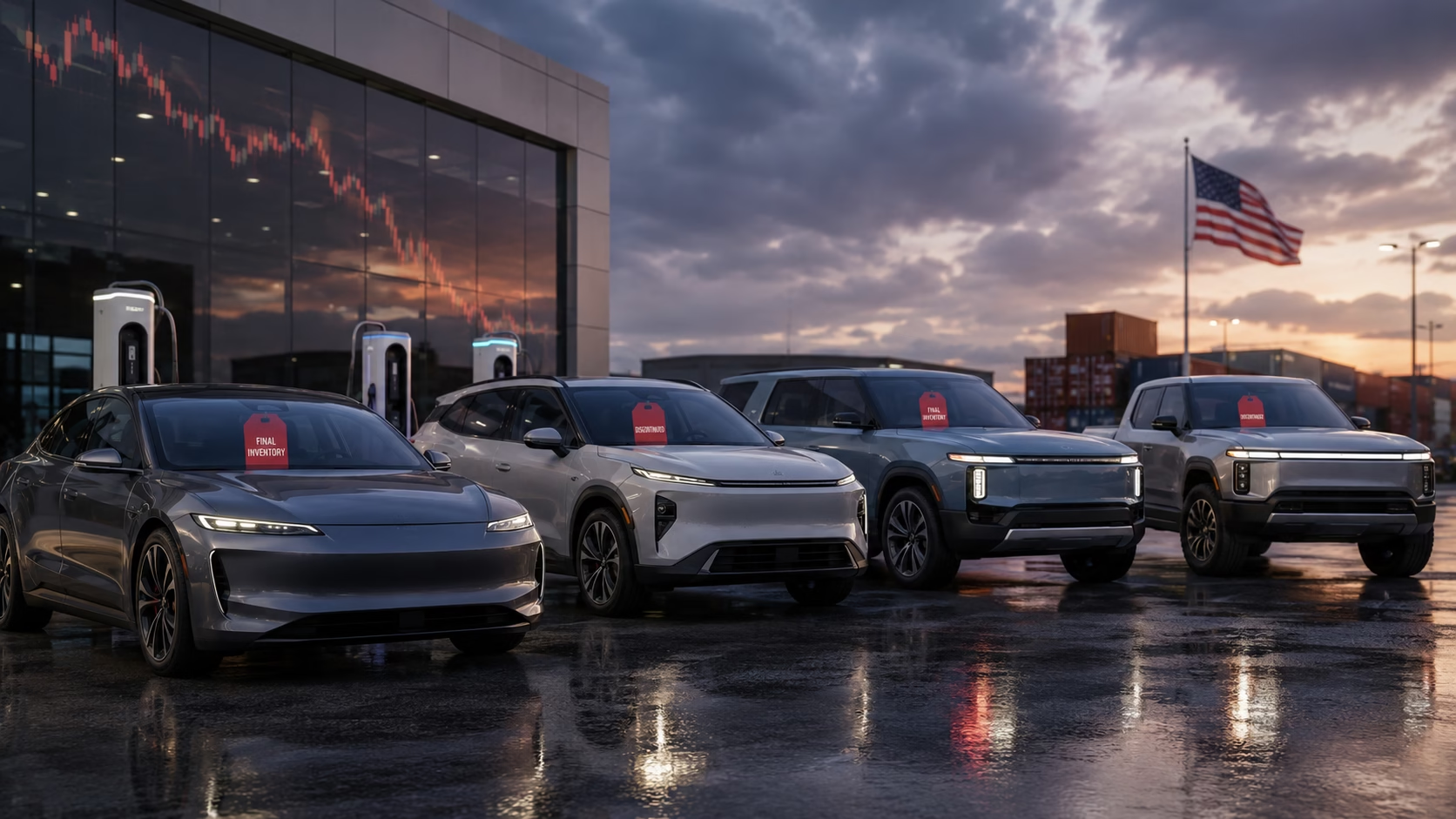
You had a model in mind, budgeted for it, maybe even test-drove it — and now you're hearing it's no longer available. That's the reality for thousands of shoppers in 2026. EV models discontinued from the US market have multiplied fast: Tesla, Volvo, BMW, Hyundai, Kia, Honda, Ford, and Nissan have all pulled vehicles from American sale this year. Some exits were strategic. Most were forced by tariffs and a collapsed federal tax credit. If you're shopping for an electric vehicle right now, you need to understand what's gone, what's still on the lot, and how to protect yourself financially either way.
This guide covers every major EV models discontinued in 2026, explains the three economic forces behind the wave of cancellations, and walks you through exactly how to finance whatever electric vehicle you find available at a price that works for your budget.
Disclaimer: This article is for educational purposes only and does not constitute financial, legal, or tax advice. Eligibility, rates, terms, and lender availability vary based on your credit history, income, property value, age, and other individual factors. Always consult a qualified professional before making any financial decision.
What Are EV Models Discontinued in 2026 and Why Is It Happening?
When we say EV models discontinued, we mean vehicles that automakers have stopped selling in the US — either permanently or indefinitely — during the 2026 model year. This is not a refresh, a facelift, or a regional trim reduction. These are cars that dealers cannot reorder, that production lines have stopped building, and that are gone from official US sales channels.
The list is longer than most buyers realize. At least a dozen electric vehicle models have been discontinued, paused, or cancelled in the US in 2026, including Tesla's Model S and Model X, Honda's entire 0 Series, the Volvo EX30, BMW's i4 and iX, and multiple Hyundai and Kia EVs. That's a significant portion of the accessible EV market disappearing inside a single calendar year.
Three forces hit simultaneously. First, the federal $7,500 EV tax credit expired in September 2025, which immediately made EVs thousands of dollars more expensive for buyers. EV sales for legacy brands fell 45.2% in February 2026 compared to the prior year. Second, the US applied 25% import tariffs on vehicles assembled outside the country. The largest category of discontinued EVs consists of models imported from outside the United States that can no longer be sold profitably under the current tariff regime. The Hyundai Kona Electric — one of the cheapest EVs on the US market at around $33,000 — was paused because Hyundai couldn't absorb the cost of shipping it from South Korean plants under that tariff structure.
Third, some exits are strategic rather than forced. BMW's i4 sedan and iX SUV are being phased out not because of tariffs or losses but because BMW is replacing them with next-generation vehicles built on its Neue Klasse platform. The space formerly devoted to the production of the Model S and the Model X in Tesla's Fremont, California factory will be converted to mass-produce Tesla's Optimus humanoid robots. The common thread across all categories: these vehicles are no longer coming to US showrooms new.
- Tesla Model S and Model X — discontinued April 1, 2026
- Volvo EX30 — canceled for US after 2026 model year
- BMW i4 and iX — phased out for Neue Klasse replacements
- Hyundai Kona Electric — paused due to import tariffs
- Hyundai Ioniq 6 (standard) — discontinued for US; Ioniq 6N limited quantities remain
- Kia Niro EV — 2026 is its final model year
- Kia EV6 GT — postponed indefinitely
- Honda 0 Series SUV and Saloon — canceled before US debut
- Acura RSX and ZDX — canceled
- Ford F-150 Lightning — production stopped December 2025
- Nissan Ariya — canceled for 2026
- Genesis Electrified G80 — canceled for US market
- Ram 1500 REV (all-electric) — canceled; range-extended version renamed
5 Real Benefits of Knowing Which EV Models Are Discontinued
1. You Can Find Remaining Inventory at Genuine Discounts
When a model is discontinued, dealers need to clear whatever's left on the lot — and they have real motivation to deal. Vehicles like the Volvo EX30 and the Hyundai Ioniq 6 standard trim may still be sitting at regional dealerships right now, often at below-invoice pricing or with added incentives like extended warranties and free home charger installation.
2. You Avoid Future Parts and Software Surprises on EV Models Discontinued From Active Production
What most people don't realize is that a discontinued EV doesn't automatically guarantee parts availability or ongoing software updates for its full expected lifespan. Some automakers honor full commitments regardless; others scale back. BMW has pledged parts and service support for its discontinued i4 and iX for at least 10 years. Honda's position on the canceled 0 Series is less clear, since those vehicles never reached production. Knowing what each automaker has committed to before you buy protects you from costly surprises at year four or five of ownership.
3. You Negotiate From a Real Position of Strength
Dealers on a discontinued model cannot reorder when inventory runs out. That shifts leverage entirely to you as the buyer. You can walk in knowing the dealer is motivated to move stock, and use that to negotiate financing terms, add-on coverage, or dealer cash-back amounts that would never be on the table for a high-demand in-production model.
4. You Make Smarter EV Financing Decisions
Financing a discontinued vehicle carries a different risk profile than financing an active model. Residual values for EV models discontinued from production tend to drop faster, which matters if you're leasing — or if you plan to sell within three to five years. Understanding this upfront helps you choose the right loan term and down payment. You can model the exact monthly cost with our Vehicle Financing Calculator, which covers all 50 states.
5. You Spot the Replacement Models Worth Waiting For
Every exit has a reason, and often a successor. BMW's i4 is making way for the new i3 sedan, which will offer up to 440 miles of range on the Neue Klasse platform. Kia is discontinuing the Niro EV to focus development resources on the more affordable EV3 and EV4. If you can wait 12–18 months, understanding the pattern of EV models discontinued tells you exactly what's worth holding out for — and what is simply gone for good.
Who Should Consider Buying a Discontinued EV Right Now?
Let's be real — discontinued EVs aren't the right move for every buyer. But for the right profile, they represent some of the strongest value in the current market.
Budget-conscious buyers with solid credit. If your credit score is 680 or above and your household income is $50,000 or more, you're well positioned to qualify for competitive financing on remaining discontinued inventory. Lenders treat newer model-year vehicles — even discontinued ones — as lower-risk collateral than older used cars. That translates to better APR offers. Income in the $65,000–$100,000 range, combined with a debt-to-income ratio under 43%, is the sweet spot most lenders want to see.
Long-term owners who plan to keep the car 7–10 years. If you're not planning to sell for a decade, the short-term drop in resale value on a discontinued model matters much less. The Volvo EX30 and BMW iX will still deliver the driving performance they promised — they just won't have a new competing model rolling off an active production line every year.
Buyers with home charging installed. Most discontinued EVs have solid charging efficiency, but they may not benefit from the future charging network partnerships automakers negotiate for their active lineups. If you rely primarily on a Level 2 home charger, that limitation matters less in day-to-day driving.
Who should wait instead? If your credit score is below 620, spend three to six months building it before applying. Even a 40-point improvement can shift you from a 15% APR to an 8% APR — a difference of thousands of dollars over a five-year loan. Visit AnnualCreditReport.com to pull your free report and identify any errors that could be dragging your score down before you start shopping.
Requirements and Documents for Financing an EV Purchase in 2026
Missing documents are the number one reason loan applications get delayed. Have everything on this list ready before you apply — whether you're buying a discontinued model on clearance or a current model still in production.
- Government-issued photo ID (driver's license or state ID)
- Social Security number for credit check authorization
- Last 2 pay stubs showing year-to-date earnings, or 2 years of federal tax returns (Form 1040) if self-employed
- Proof of residence — a utility bill or bank statement dated within the last 60 days
- Vehicle information: VIN, make, model, trim, and mileage if pre-owned
- Proof of insurance or a binder showing coverage effective on the purchase date
- Down payment funds — most lenders require at least 10%; 20% gets you the best rate tier
- Trade-in documentation if applicable: vehicle title, current registration, and existing loan payoff amount
- Home charger installation documentation if applying for a green lending program or utility rebate
Some discontinued models may still carry unadvertised regional dealer incentives or remaining manufacturer holdback funds. Ask specifically about any in-stock EV models discontinued from the active lineup — dealers sometimes have discretionary cash available for last-unit sales that never makes it into the advertised price.
Best Lenders for EV Financing in 2026 — Comparison
Whether you're financing a discontinued EV at clearance pricing or picking up a model still in production, the lender you choose will have a bigger impact on your total cost than almost any other decision. Here's how leading personal loan and auto lenders compare right now.
| Lender | APR Range | Loan Amount | Min. Credit Score | Time to Fund |
|---|---|---|---|---|
| LightStream | 6.99% – 25.49% | $5,000 – $100,000 | 660 | Same day |
| PenFed Credit Union | 5.24% – 17.99% | $500 – $150,000 | 650 | 1–2 business days |
| SoFi | 8.99% – 29.99% | $5,000 – $100,000 | 680 | Same or next day |
| Upgrade | 9.99% – 35.99% | $1,000 – $50,000 | 580 | 1–4 business days |
| LendingClub | 9.57% – 35.99% | $1,000 – $40,000 | 600 | 1–3 business days |
Rates are approximate estimates based on current market conditions as of May 2026. Always verify current rates directly with the lender before applying.
LightStream is the standout choice for well-qualified buyers. If your credit score is 720 or above, their auto loan rates come in consistently below 10% — which, in the current rate environment, is genuinely competitive. They also offer a rate-beat program that challenges competing offers, giving you real price discovery before you commit.
PenFed Credit Union offers the lowest starting APRs on this list, particularly for vehicle loans. Membership is open to anyone in the US — no military affiliation required. Their higher loan limits (up to $150,000) make them a strong pick if you're financing a higher-cost discontinued model like the BMW iX or a Tesla Model X that's still sitting on a lot at MSRP.
SoFi stands out for speed and zero origination fees. If you need same-day funding and want to avoid front-end costs eating into your clearance discount, SoFi is worth checking first. Their pre-approval process is fully digital and takes under ten minutes.
Upgrade is the practical option for buyers whose credit score falls in the 580–660 range. The APRs are higher, but their approval criteria are more accessible. Use our Vehicle Financing Calculator to model what a higher APR actually adds to your total cost before you decide whether to wait for a better score or proceed now.
LendingClub works well as a secondary application if you've been turned down elsewhere. Their peer-funded model can be more flexible for borderline credit profiles. For a plain-language breakdown of how personal loans work in vehicle financing, the FTC's personal loan guide is a solid starting point.
Rates, APR, and Loan Terms for EV Buyers in 2026
How the Current Rate Environment Affects Discontinued EV Financing
As of May 2026, the Federal Reserve rate is 4.25–4.50% and the Prime Rate is 7.50%. These benchmarks directly influence what lenders charge on auto and personal loans. The elevated rate environment means that even well-qualified buyers are paying APRs that were considered high just two years ago — which makes the clearance discounts on discontinued EVs even more important to capture.
APR and interest rate are not the same thing. APR — Annual Percentage Rate — includes your interest rate plus any origination fees charged upfront. On a $40,000 loan, a 5% origination fee adds $2,000 to your real borrowing cost before you ever make a payment. Lenders like LightStream and SoFi charge no origination fees; others go up to 9.99%. Here's what works as a quick check: always ask for the total loan cost in dollars, not just the monthly payment.
Loan term length is where most buyers make expensive mistakes. A $40,000 loan at 9% APR over 72 months costs roughly $7,800 in interest over the life of the loan. The same loan over 48 months costs about $5,000. The monthly payment difference is around $180 — but the interest savings is nearly $3,000. If a discontinued EV is available at a 15% clearance discount, a shorter loan term lets you keep more of that saving in your pocket rather than giving it back as interest.
One factor specific to EV models discontinued from active production: some lenders reclassify vehicles that have been sitting on a lot for more than 90 days as used inventory, which triggers a higher APR tier. Ask the dealer and your lender directly how the vehicle will be classified before you apply. For the latest consumer lending trend data, the Federal Reserve's G.19 Consumer Credit report is updated monthly and gives you a real-time baseline for what rates look like across the market.
Tips to Get Your EV Financing Approved Fast
- Pull your credit report 30 days before applying. Visit AnnualCreditReport.com for your free report from all three bureaus. Dispute any errors before you apply — a single corrected late payment can raise your score by 20–40 points and move you into a better rate tier.
- Get pre-approved from at least two lenders before visiting the dealership. Pre-approval uses a soft inquiry — it does not hurt your score. Walking in with a pre-approved rate in hand gives you an anchor for negotiating dealership financing offers, especially on EV models discontinued from the lineup where the dealer has extra motivation to close the deal.
- Have the VIN ready before you apply. Many lenders need the Vehicle Identification Number to finalize your APR, particularly for discontinued models where they'll want to verify the model year and title status. Getting this from the dealer upfront speeds up approval by one to two days.
- Bring at least 10% down — 20% is better. A larger down payment reduces your loan-to-value ratio, which lenders use to assess default risk. It immediately lowers your monthly payment and reduces the total interest you'll pay. On a $35,000 discontinued EV, a $7,000 down payment versus $3,500 saves you hundreds in interest at current APRs.
- Do not apply for any new credit in the 60 days before your loan application. New credit cards and personal lines of credit show up as hard inquiries and temporarily lower your score. Hold off until your auto loan is fully approved and funded.
- Ask about rate-lock options if you need more time to negotiate the vehicle price. Some lenders will lock a pre-approved rate for 30–45 days. That window lets you negotiate the best clearance deal on remaining discontinued inventory without the risk of your quoted rate expiring mid-negotiation.
- Check your debt-to-income ratio before applying. Most lenders want to see a DTI under 43%. If yours is higher, pay down one credit card balance before applying — reducing a card's utilization from 80% to 30% can improve your profile enough to qualify for a lower rate tier. For broader guidance on managing your credit before a vehicle purchase, the FDIC's Credit and Loans resource center has straightforward, lender-neutral guidance.
You can browse our full Electric Cars section for more detailed breakdowns of the current EV market, model comparisons, and financing strategies for buyers at every credit level.
Frequently Asked Questions About EV Models Discontinued in 2026
Can I still get a discontinued EV with no credit check?
The short answer is: rarely, and not through a standard lender. Some buy-here-pay-here lots may skip a hard credit check, but those arrangements carry APRs of 20% or more and very limited inventory selection. Franchised dealerships holding remaining stock of discontinued EV models — Volvo, BMW, Hyundai, and others — work with institutional lenders that require a credit check as part of the application. If your credit history is thin, a co-signer or three to six months of credit-building activity will put you in a meaningfully stronger position.
What credit score do I really need to finance an EV in 2026?
Here's what works in practice: most competitive lenders start at 660, and you'll see the best APR tiers at 720 or above. Lenders like Upgrade and LendingClub go down to 580, but at that level, your APR could land between 20% and 35%. On a $35,000 discontinued EV financed at 24% APR over 60 months, you'd pay over $23,000 in interest alone — more than doubling the vehicle's effective cost. The credit score goal is real, not just a formality.
How fast can I actually get the money for an EV purchase?
If you're fully pre-approved and have all your documents ready, same-day funding is achievable with lenders like LightStream and SoFi. In practice, the full process — application, approval, and disbursement to the dealer — typically runs one to three business days. The bottleneck is almost always document verification, not the lender's credit decision. Have your last two pay stubs, government ID, and insurance binder ready before you start the application, and the timeline tightens considerably.
Will applying for EV financing hurt my credit score?
Pre-approval requests are soft inquiries — they do not affect your score. A formal loan application involves a hard inquiry, which typically reduces your score by about 3–5 points temporarily. What most people don't realize: if you submit multiple auto loan applications within a 14-to-45-day window, the three major credit bureaus treat them as a single inquiry for rate-shopping purposes. You can compare four or five lenders in that window without accumulating multiple hard inquiry penalties on your score.
Can I get approved to buy a discontinued EV after a bankruptcy?
Yes, but expect higher rates and stricter terms. If your bankruptcy was discharged more than two years ago and you've built some positive payment history since, lenders like Upgrade and OneMain Financial may approve you. Expect APRs in the 25%–35% range and a required down payment of 20% or more. A Chapter 7 bankruptcy stays on your credit report for up to 7 years from the discharge date; Chapter 13 for 7 years from the filing date. Using that period to build consistent payment history on smaller accounts before pursuing a vehicle loan puts you in a much stronger position when you're ready to buy.
What happens if I miss a payment on my EV loan?
Most lenders build in a 10-to-15-day grace period before a late fee applies — typically $25–$50 or 5% of the missed payment, whichever is greater. If payment is 30 days late, it gets reported to the credit bureaus, and your score can drop 60–110 points depending on your overall profile. At 90+ days overdue, most lenders begin repossession proceedings. The practical advice: if you anticipate a cash flow problem, contact your lender before you miss the payment — many have documented hardship deferral programs that allow one or two skipped payments without negative credit reporting. This matters especially for buyers of discontinued EVs, where unexpected repair costs outside warranty coverage can add financial pressure mid-loan.
Should I buy a discontinued EV now or wait for a replacement model?
It depends on how long you plan to own the car and how deep the clearance discount actually is. If the discontinued model is priced 12%–20% below its original MSRP and you plan to keep it for seven or more years, the deal often makes strong financial sense. If you can wait 12–18 months, the replacement models arriving for BMW, Kia, and others will offer meaningfully better range and charging performance. What most people don't realize is that waiting carries its own risk: clearance inventory on discontinued models moves faster than most buyers expect, and once the last units are gone, you're back to paying full price for whatever is currently in production. Use our Vehicle Financing Calculator to compare the total cost of a discounted discontinued model versus a new replacement at full price.
Conclusion: Turn the 2026 EV Disruption Into a Buying Opportunity
The wave of EV models discontinued in 2026 is one of the most significant reshapings of the American automotive market in years. But disruption creates real opportunity for prepared buyers. If you know which models still have available inventory, understand how tariffs and the end of the federal tax credit affect pricing and residual values, and secure a pre-approved loan rate before walking into any dealership, you can come out of this market moment ahead — not behind.
Key takeaways: at least a dozen EV models are discontinued or cancelled in 2026 due to tariffs, the expired $7,500 tax credit, and slowing demand. Clearance discounts on remaining inventory are real but won't last. Get your credit in shape, compare at least two or three lenders, and use shorter loan terms to keep your total interest cost under control in the current elevated rate environment.
Ready to run the numbers on a specific vehicle? Our free Vehicle Financing Calculator covers all 50 states and lets you compare monthly payments across different loan terms and APRs in about two minutes. You can also explore our full Car Financing resource library for deeper guidance on auto loan strategy.