
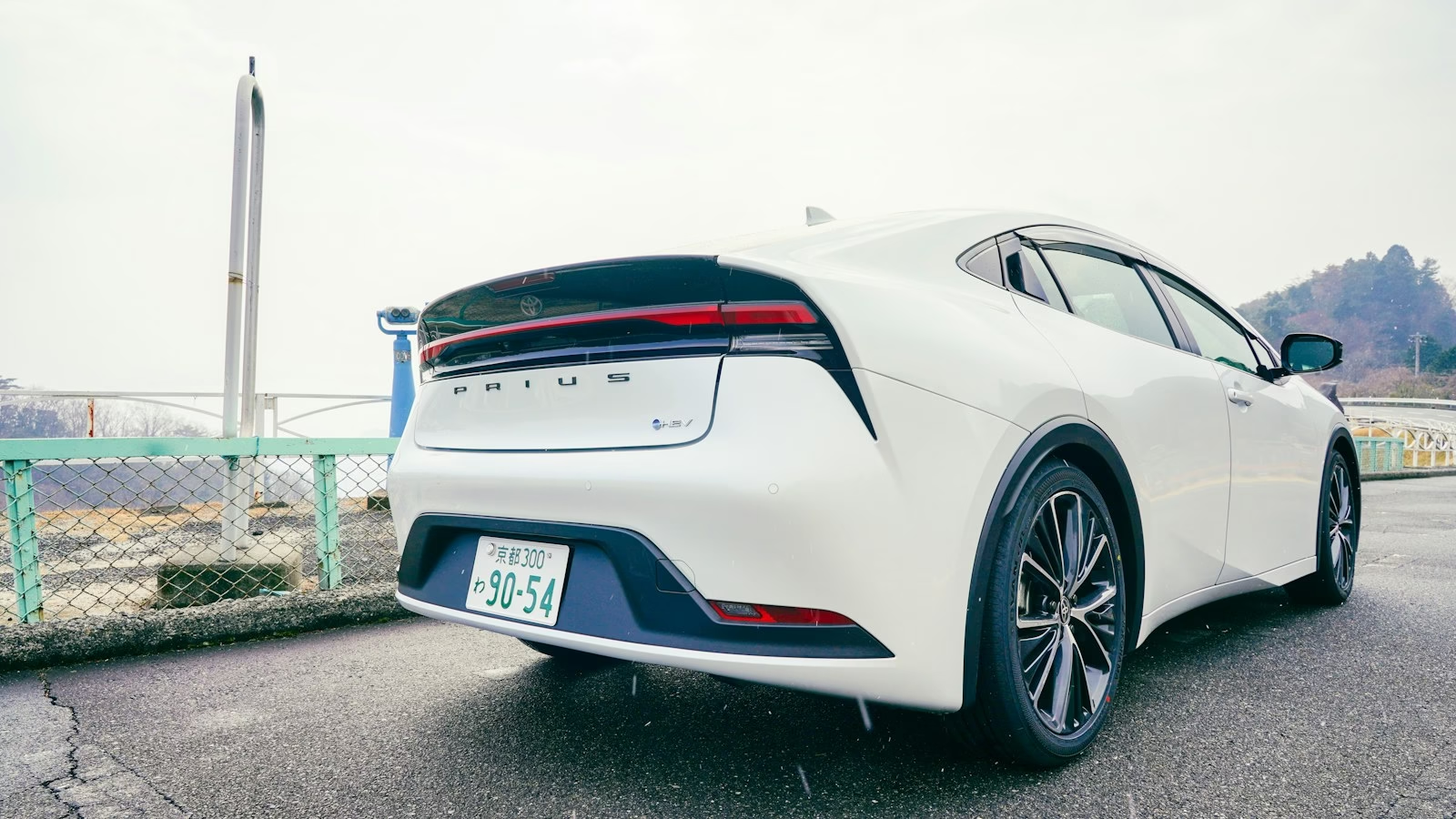
Published October 15, 2026 · By

Quick answer: When comparing a hybrid car lease vs buy decision, evaluate cash paid up front, monthly financing or lease charges, mileage and wear limits, insurance, expected maintenance, fuel costs and the vehicle's value at the end of your planned ownership period. A lease may have a lower monthly payment, but it generally pays for use rather than building ownership. Buying may cost more per month but can leave you with an asset to keep or sell. Neither is always cheaper, and the correct answer changes with the specific model and how long you plan to drive it.
Hybrid cars are often considered for fuel savings, commuting convenience and reduced gasoline use. Those benefits do not automatically determine whether leasing or buying is the most economical financing choice. A long-distance commuter who exceeds a lease's mileage allowance could face significant charges, while a driver who replaces vehicles every three years might value a clear return option. A household that plans to keep a reliable hybrid for eight or ten years may see a different advantage from outright ownership. The CFPB explains key differences between consumer auto leasing and purchasing.
Editorial note: Prepared October 15, 2026. Price, depreciation, APR, residual value and tax treatment depend on real offers and circumstances. The numerical examples are illustrative, not live lender quotes. This article is general education, not individualized tax or legal advice.
Hybrid car lease vs buy: what changes
Buying through a loan is an arrangement in which the consumer finances ownership of the vehicle and gradually repays principal and interest. The car can generally be sold, traded or kept after paying the loan, subject to liens and the contract. Leasing typically provides use for a defined period and mileage allowance; payments reflect factors such as expected depreciation, rent charge and fees. At the end, the lessee generally returns the vehicle, purchases it under an available option or follows another contractual exit process. The right choice depends on how these structures line up with your driving and future plans.
A lease is not simply a smaller car payment. Upfront amounts, taxes, excess mileage, wear charges, insurance requirements and early termination obligations can change the total. Likewise, a loan's payment includes building equity but can expose the owner to falling resale values and unexpected repairs. Comparing only monthly amounts leaves out the main economic differences.
Model-specific hybrid costs to consider
Hybrid technology varies. Conventional hybrids use gasoline and electricity captured from braking and generated through onboard systems; plug-in hybrids may also use energy from external charging and have a different operating pattern. Fuel consumption, battery design, service requirements, resale interest and insurance depend on the exact model and year. Comparing a generic 'hybrid' with a generic 'gasoline car' is too imprecise to support a financing decision. First identify the trim, drivetrain, standard equipment, fuel economy ratings and plausible alternative for your household.
For a plug-in hybrid, calculate whether you will actually charge it frequently. Paying extra for a plug-in model may not yield the expected efficiency advantage if you lack convenient charging or mostly drive beyond its electric range. For a conventional hybrid, consider real-world urban versus highway driving because the relative benefit can vary. Use FuelEconomy.gov to compare official model-specific fuel economy labels and annual fuel-cost estimates using assumptions relevant to your needs.
Hybrid car lease vs buy: five-year cost framework
Choose a common time horizon, such as five years, and calculate the total cash you would spend under each arrangement. For a purchase, include the down payment, principal-and-interest payments, taxes, fees, insurance, service and fuel, then subtract an estimated net resale value at the end if you plan to sell. For a lease, include upfront amounts, lease payments, end-of-lease charges, insurance, service, fuel and any other contractual amounts. If a buyout is planned, add the contract price and related costs. The best comparison uses actual offers for the same car and a consistent ownership horizon.
Depreciation estimates are inherently uncertain. A hybrid can retain value well in one region or lose value quickly after a manufacturer changes pricing or design. Do not treat a resale projection from a dealership as guaranteed. Run a conservative resale scenario and a less favorable one, then look for an option that remains affordable if the market changes.
Hybrid car lease vs buy: illustrative cost example
| Item | Hypothetical purchase | Hypothetical lease |
|---|---|---|
| Vehicle | Same new hybrid model | Same new hybrid model |
| Cash at signing | $4,000 | $3,000 |
| Monthly payment | $530 | $390 |
| Time considered | 36 months initially | 36-month lease |
| Payments plus signing cash | $23,080 in first 36 months | $17,040 in first 36 months |
| After 36 months | Borrower still owes a loan balance but owns value in car | Lessee returns or follows the buyout terms |
| Mileage and condition | Influence resale value | May create contractual end-of-lease charges |
The hypothetical lease uses less cash through month 36, but this does not prove it is cheaper. The financed car has value and an outstanding balance, while the lease may have a buyout price or return charges. A five-year analysis requires evaluating what happens in years four and five under each option. Repeatedly leasing can create a recurring payment obligation; buying and keeping the car can eventually eliminate that obligation once financing is satisfied.
Lease mileage limits matter for commuters
Consumer auto leases commonly define an annual mileage allowance and a charge for miles above that limit. The CFPB notes typical limits around 10,000 to 15,000 miles per year, but your contract's actual figures control. A hybrid shopper who drives 20,000 miles annually should calculate the potential charge rather than assuming hybrid fuel savings overcome it. For example, a hypothetical 5,000 excess miles at $0.25 per mile would create $1,250 in additional end-of-term cost, excluding other charges. That rate is illustrative, not a quote.
If a dealer proposes buying more mileage upfront, compare its price with expected excess-mile charges and the risk that your travel needs will change. A long-distance driver who keeps a car after loan payoff may value the absence of lease mileage caps, even though heavy usage still lowers resale value. The relevant consideration is an enforceable contractual fee versus market depreciation, not the simplistic claim that buying permits 'free' extra miles.
Hybrids and residual value: who bears the risk?
In a purchase, the owner typically carries the risk that the vehicle will be worth less than expected when sold, and benefits if resale value remains strong. The financing balance can create negative equity when it exceeds sale or trade value. In many closed-end leases, the lessor bears certain residual value risks if the car is returned in accordance with the contract, but the lessee can still owe wear, mileage or other charges. There are important variations in lease structures, so read the written terms rather than assuming every agreement is a standard walk-away lease.
Ask the dealer how the residual value and purchase option are defined and whether the option can change. If the future buyout seems appealing, compare it with a reasonable range of future used-car values and consider taxes and fees. Buying a car at lease-end can be sensible in some circumstances, but a fixed purchase option is not automatically a bargain.
Hybrid car lease vs buy: battery warranty and service
Hybrid cars have additional electric drive components and a traction battery, and the applicable warranty varies by manufacturer, model and state. Ask what the coverage includes, whether it carries a capacity threshold, and when it ends. Leasing a vehicle for a short term may limit the period during which you directly confront later aging risks, but that is not a guarantee of zero repairs. Buying and keeping the vehicle longer may require a reserve for components that age after warranty protection expires.
Do not make sweeping claims that hybrid batteries must be replaced at a fixed mileage. Our hybrid battery lifespan guide provides broader context. For financing decisions, the key is how the warranty term compares with the expected ownership and loan horizon, and whether authorized repair providers are accessible near you.

Fuel savings are the same only if your driving is the same
When comparing a lease and purchase of the exact same hybrid, the underlying fuel economy does not change just because the financing structure changes. A salesperson may present the fuel savings as a reason to lease, but those same operating savings could exist if you bought the car. To evaluate hybrid versus gasoline alternatives, use estimated miles divided by fuel economy to calculate yearly gallons, then multiply by a realistic gasoline price. Adjust for highway share, cold weather and vehicle maintenance needs rather than treating EPA estimates as exact future bills.
For example, 12,000 miles at 45 mpg would use roughly 267 gallons in a simple annual calculation, while 12,000 miles at 30 mpg would use about 400 gallons. At a hypothetical $3.50 per gallon, the difference is around $467 per year before changes in driving conditions or fuel prices. These hypothetical efficiencies are not specific model ratings and do not determine which financing contract is cheaper. They simply illustrate operating cost comparisons.
Insurance, taxes and dealer fees may differ
Before deciding, obtain insurance quotes for the exact model, drivers and coverage. Lease providers often impose coverage requirements, and lenders financing a purchase may also require comprehensive and collision insurance. Higher deductibles can reduce premiums but increase out-of-pocket exposure after a claim. Fees and state taxation of leases and purchases vary, so ask dealers for written, itemized offers tied to the same vehicle and location. Do not rely on a national example to infer your state taxes.
Compare acquisition and disposition fees on a lease with origination, title or other finance-related charges on a loan. Ask whether optional protection products are truly optional and whether they are reflected in the quoted monthly payment. The FTC recommends obtaining out-the-door prices and reviewing add-ons rather than discussing only a manageable-sounding installment.
What happens if you must exit early?
Ending a lease before maturity can be expensive. The CFPB warns that early termination fees may be substantial, and returning the car does not automatically extinguish future obligations. Ask how the contractual settlement would be calculated if you needed to move, reduce household expenses or switch cars. For a purchased vehicle, selling it requires paying the remaining loan balance and any applicable payoff charges. Negative equity can still create a deficit, but the mechanics differ.
A household expecting relocation, rising mileage or a change in family needs should give flexibility meaningful weight. A lower lease payment has little advantage if breaking the contract after 18 months produces costs the borrower cannot afford. Request written exit illustrations rather than relying on a generic statement that you can 'trade out anytime.' The ability to hand back keys under one agreement is not the same as having no further debt.
Compare a new hybrid with a certified pre-owned hybrid
The decision is not limited to new-car leasing versus new-car financing. Buying a used hybrid can lower the amount financed, though condition and battery warranty remaining must be checked. Certified pre-owned programs may include inspections and warranties, but their terms vary by seller and manufacturer. Compare a specific used vehicle's history, inspection report, applicable warranty, out-the-door price and expected maintenance with the new vehicle's lease terms. Do not assume a 'certified' label guarantees absence of hidden issues or full coverage of high-voltage components.
An independent inspection can identify wear, accident repairs and repair needs that affect ownership cost. The FTC emphasizes vehicle history and independent inspections for used-car purchasers. Your mileage and ownership horizon then determine whether the used hybrid's lower purchase cost offsets its likely higher near-term maintenance risk.
Credit approval and financing terms
Lease and loan pricing depend on borrower qualifications and the specific manufacturer or finance provider. A promoted monthly payment may require strong credit, a particular down payment and a limited vehicle configuration. Ask for the actual lease disclosure or loan APR applicable to your application, not the most attractive marketing figure. For a purchase, compare lender offers before visiting the dealership so you have a reference point for negotiating.
A soft prequalification is not the same as final approval, and an attractive quoted APR may change with underwriting. Check fees, term, due dates and any conditions before signing. Avoid rolling unrelated add-on products into financing without understanding total cost. Your goal is a vehicle and payment that fit the household's long-term finances rather than a promotional offer designed for a different credit profile.
A three-scenario comparison framework
Calculate at least three realistic cases. Scenario one: keep the hybrid three years and replace it. Include end-of-term lease charges or three-year loan payoff and resale value. Scenario two: keep it five years; the shorter lease may require another lease or buyout, while the purchase may still have installments. Scenario three: retain it eight years and evaluate maintenance and battery-warranty exposure after financing is complete. Use the same driving mileage and fuel-cost assumptions to avoid accidentally comparing different lifestyles.
The value of this method is not precision in predicting resale markets. It is exposing which assumptions drive the decision. If buying looks better only under an optimistic resale price, increase your risk estimate. If leasing seems cheaper only because you excluded the replacement car in years four and five, correct the time horizon. A comparable analysis is more useful than a manufacturer advertisement.
Hybrid Car Lease vs Buy: 5 Costly Mistakes to Avoid
A useful hybrid car lease vs buy calculation uses the same vehicle trim, tax assumptions, expected annual mileage and comparison period. The five mistakes below can make an apparently attractive quote more expensive after the contract is signed.
1. Comparing only the monthly payment
A lease payment can be lower than a loan payment even when the five-year out-of-pocket cost is higher. Add cash due at signing, all monthly charges, registration, lease-end fees and any down payment. For a purchase, subtract a conservative estimated resale value at the end of the same period. Do not count refundable security deposits as permanent costs unless a specific charge would forfeit them.
2. Ignoring excess-mileage and wear charges
Estimate real annual miles from commuting, school trips and travel, then compare that number with the lease allowance. Ask for the per-mile overage charge and the standards used to assess return condition. A driver who frequently exceeds the allowance should model that cost before choosing a hybrid lease.
3. Assuming fuel savings decide the financing choice
A hybrid may consume less gasoline than a comparable non-hybrid model, but that benefit may apply whether you lease or buy the same hybrid. When evaluating hybrid car lease vs buy, isolate financing and ownership costs rather than counting the same fuel savings as an advantage for one contract.
4. Overlooking insurance and sales-tax differences
Get insurance quotes for both contract structures and verify applicable local sales or use taxes, title fees and registration. Some lessors specify insurance limits. The quoted payment may omit costs that appear elsewhere in the total amount paid.
5. Overestimating future resale value
A purchase builds equity only if the vehicle's value after outstanding debt is positive. Use more than one conservative resale scenario, especially if you plan to change cars quickly. A hybrid car lease vs buy decision should still make sense if resale value is lower than expected.
Before signing: request itemized lease and loan disclosures for the same trim and mileage assumptions. Keep a written worksheet showing what you would pay over three and five years.
Questions to ask before leasing or buying a hybrid
- What is the complete out-the-door purchase price for this exact trim?
- What are cash due at signing, monthly charges and total lease cost?
- What mileage allowance and excess-mile fee apply?
- What are the disposition, wear, early termination and buyout rules?
- What APR, fees and remaining balance would a purchase loan involve?
- How do insurance costs and warranties compare?
- Will the vehicle meet your needs after three, five and eight years?
Request a written proposal for both structures and preserve it. Avoid evaluating a lease solely from a promotional monthly amount or a loan solely from its advertised rate. A meaningful total-cost comparison accounts for what you own or owe when the planned time horizon ends.
Hybrid car lease vs buy: frequently asked questions
Is leasing a hybrid always cheaper?
No. Leasing can have a smaller monthly payment but creates end-of-term obligations and generally does not build ownership unless a buyout applies.
Do hybrid fuel savings favor leasing over buying?
Not inherently. The same vehicle consumes fuel similarly regardless of the financing structure under the same driving conditions.
Will high mileage make a lease expensive?
It can if the contract imposes excess-mile charges. Calculate the fee using realistic annual travel.
Can you buy a hybrid after leasing it?
Some contracts allow an end-of-term purchase at a stated or determined price. Verify that option before signing.
Is buying better if you plan to keep a car for ten years?
Ownership may become more attractive after financing ends, but maintenance, insurance, battery and resale risks still matter.
Bottom line
Choose a hybrid lease or loan using the full contract and a consistent ownership horizon. Weigh cash flow, end-of-term value, mileage, insurance and warranty coverage. A lease may fit shorter replacement cycles, while buying may suit long-term ownership; neither is universally the better deal. Compare the exact offers, not assumptions about hybrids as a category. For additional context, see our hybrid versus electric car guide and research methods.