
Published May 25, 2026 · By

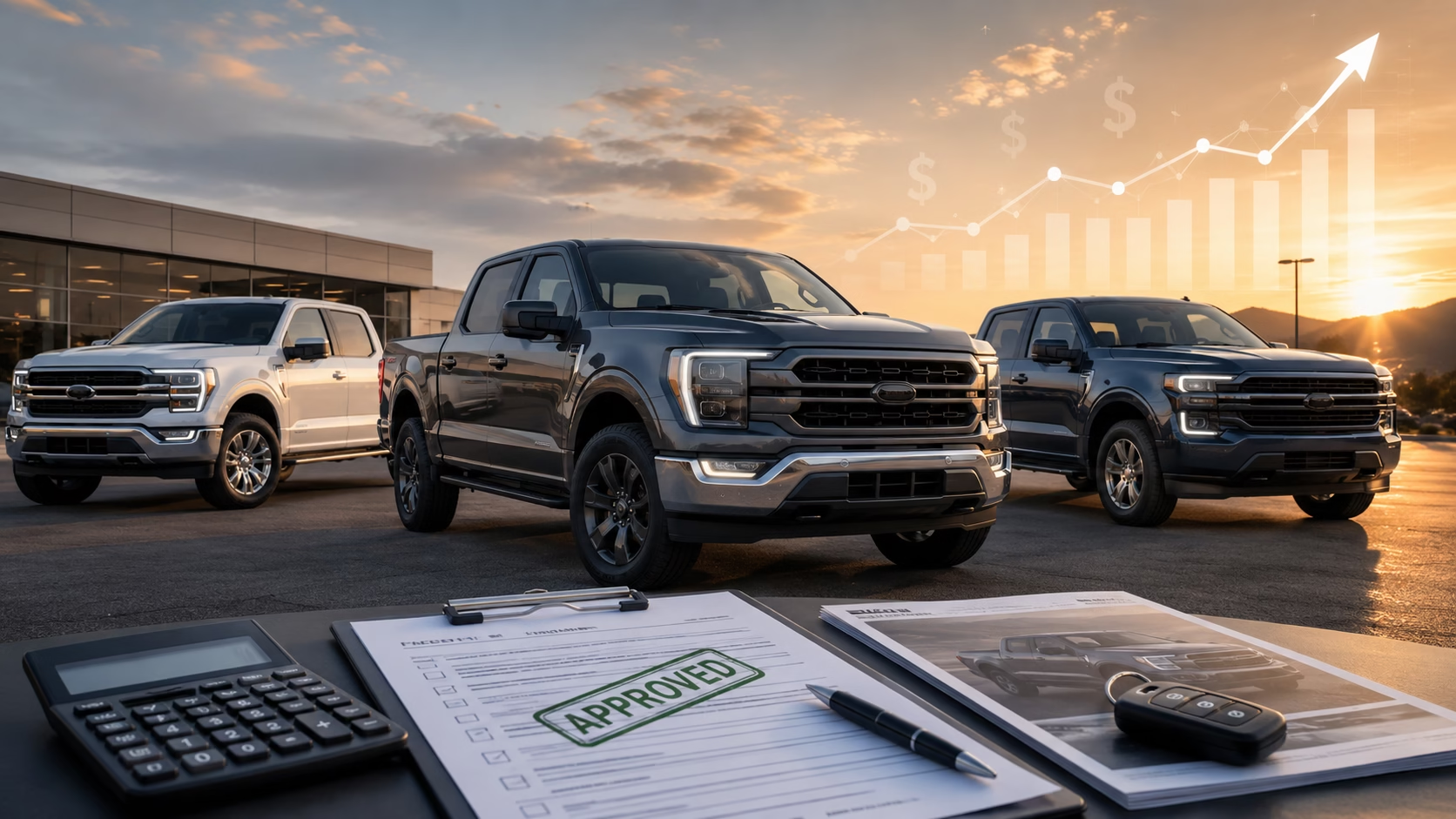
You've been looking at a new F-150, a Ram 1500, or a Silverado — and the price tag is anything but small. The average transaction price for a new full-size pickup truck in 2026 is sitting above $58,000, and a well-equipped used model can still run $35,000 or more. For most buyers, pickup truck financing is the only practical path to getting behind the wheel without draining every account they have.
The real problem isn't the price — it's that two buyers with nearly identical credit scores can walk away from the same dealership paying APRs that are 4 to 6 percentage points apart. That gap doesn't come from bad luck; it comes from one buyer doing their homework and the other signing whatever the dealer put in front of them.
This guide gives you a clear, no-fluff picture of how truck financing works in 2026, which lenders offer the most competitive terms, what you need to qualify, and the specific steps that speed up approval. Whether you're buying new, buying used, or refinancing a truck you already own — here's what works.
What Is Pickup Truck Financing and How Does It Work
Pickup truck financing is a loan — secured against the vehicle or taken as a personal installment loan — used to purchase a new or used pickup truck. You borrow a fixed amount, agree to a repayment term (typically 36 to 84 months), and pay it back in equal monthly installments that include both principal and interest.
Here's a concrete example so the math is real: you're buying a 2025 Chevy Silverado 1500 for $54,000. You put $6,000 down, leaving a $48,000 balance. At a 7.5% APR over 60 months, your monthly payment is around $962, and total interest paid comes to roughly $9,700. Extend that to 72 months and the payment drops to about $828 — but you'll pay over $11,600 in interest before the loan is retired.
There are two main financing channels. Direct lending means you lock in a pre-approved loan from a bank, credit union, or online lender before you set foot in a dealership — giving you a known rate and real negotiating power. Dealership financing means the dealer connects you with their lending partners. It's convenient, but dealers often add a markup to the lender's wholesale rate (called the "dealer reserve") that goes straight into the dealer's pocket.
What most people don't realize is that the vehicle's age matters almost as much as your credit score. Lenders view a 2024 F-150 very differently from a 2017 F-150. Older trucks carry more collateral risk as values drop and repair costs rise, and many lenders either cap the loan amount or charge noticeably higher rates on vehicles older than seven years.
To see exactly how rates, terms, and down payments interact on your specific numbers, use our free Vehicle Financing Calculator — available for all 50 states. For a plain-language primer on how installment loans work, the Consumer Financial Protection Bureau has a solid explanation.

5 Real Benefits of Pickup Truck Financing
1. You Keep Your Cash Available for What Matters
Paying $55,000 in cash for a truck ties up capital that could serve you better elsewhere — an emergency fund, a home down payment, business operations, or even a high-yield savings account earning 4–5% annually right now.
Even buyers who could pay cash outright often choose to finance when the loan APR is low enough that borrowing costs less than what that capital earns sitting in an investment account.
2. You Get Into a Better Truck Right Now
Financing lets you move into a newer, safer, and more capable truck today instead of waiting two or three years to save up. For work trucks especially, a newer model means better towing capacity, improved payload ratings, modern safety systems, and lower fuel costs — all of which translate to measurable savings over time.
The short answer is: a truck that earns or saves more than it costs to finance is a sound financial move, not a burden.
3. On-Time Payments Build a Stronger Credit Profile
An auto loan is an installment account, and consistent on-time payments are one of the most effective ways to strengthen your FICO score. Many borrowers see meaningful score gains within 12–18 months of steady payments on a new truck loan.
That improved score then helps you access better rates on a future mortgage, business line of credit, or the next vehicle you finance.
4. Lenders Are Competing for Qualified Truck Buyers in 2026
Despite the elevated rate environment, credit unions and online lenders are offering auto loan rates that are meaningfully lower than most dealership financing options. Shopping around — even spending 45 minutes getting pre-qualified online — can realistically save you $1,500 to $4,000 over the life of a typical truck loan.
That's real money, and it costs you nothing but a few soft credit pulls.
5. Flexible Terms Let You Match Payments to Your Cash Flow
Pickup truck financing terms run from 36 to 84 months. Shorter terms mean higher monthly payments but lower total interest; longer terms lower your payment but increase the overall cost. Neither is automatically right — it depends on your budget, how long you plan to keep the truck, and how much total interest you're willing to pay.
Run both scenarios side by side with our Vehicle Financing Calculator before you decide.
Who Qualifies for Pickup Truck Financing?
Let's be real: lenders are looking for specific signals when they decide whether to approve you — and what rate to offer. Here's what each of those signals actually means in practice.
Credit Score: Prime lenders — banks, credit unions, and platforms like LightStream — generally want a minimum FICO score of 640 to 660. To access rates below 7% APR, where the real savings accumulate on a large truck loan, you'll want a score of 720 or higher. Borrowers in the 580–639 range can still find legitimate options through lenders like Upstart or Upgrade, but expect rates that reflect the added risk.
Debt-to-Income Ratio (DTI): Most lenders don't advertise a hard income floor, but they scrutinize your DTI closely. A DTI under 36% is considered healthy. If your total monthly debt payments — including the new truck payment — would exceed 43% to 45% of your gross monthly income, most prime lenders will pass on your application.
Employment and Income Stability: W-2 employees with at least two years of steady history at the same employer are the lowest-risk profile from a lender's perspective. Self-employed borrowers can absolutely qualify — but expect to provide two years of federal tax returns and possibly a current profit and loss statement to prove income consistency.
Down Payment: You can technically finance 100% of the purchase price. But putting 10–20% down signals financial discipline, lowers your loan-to-value (LTV) ratio, and often earns you a meaningfully better rate. It also protects you from going underwater — owing more than the truck is worth — as the vehicle depreciates in the first few years.
Vehicle Age and Mileage: Most lenders finance trucks up to 10 to 12 years old, but rates climb and loan amounts get capped for older vehicles. For trucks older than seven years with high mileage, expect fewer lender options and stricter terms. Our full Truck Loans guide covers financing options for older models in detail.
Requirements and Documents for Pickup Truck Financing
Having your paperwork organized before you apply is one of the simplest ways to speed up approval. Here's exactly what most lenders will ask for — with no vague placeholders:
- Government-issued photo ID — valid driver's license or U.S. passport
- Proof of income (W-2 employees) — last 2 consecutive pay stubs
- Proof of income (self-employed) — last 2 years of federal tax returns (Form 1040) plus a current profit and loss statement
- Proof of residence — utility bill, bank statement, or lease agreement dated within the last 60 days showing your current address
- Social Security Number (SSN) — required for credit verification and identity confirmation
- Proof of auto insurance — most lenders require coverage to be in place before releasing loan funds
- Vehicle details — VIN number, year, make, model, current mileage, and agreed purchase price
- Bank statements — last 2 to 3 months of statements (some lenders require these to verify consistent income deposits)
- Personal references — 3 to 5 references with name and phone number (required by some subprime lenders)
Before you submit a single application, pull your free credit reports from all three bureaus at AnnualCreditReport.com. Even one reporting error — a late payment that belongs to someone else, a paid collection still showing as open — can cost you a full percentage point on your rate or trigger an outright decline. Dispute any errors before you apply.
Best Lenders for Pickup Truck Financing in 2026 — Comparison
| Lender | APR Range | Loan Amount | Min. Credit Score | Time to Fund |
|---|---|---|---|---|
| PenFed Credit Union | 5.19% – 17.99% | $500 – $150,000 | 650 | 1–2 business days |
| LightStream | 6.49% – 25.99% | $5,000 – $100,000 | 670 | Same day possible |
| SoFi | 8.99% – 29.99% | $5,000 – $100,000 | 650 | Same day to 3 days |
| Upstart | 6.70% – 35.99% | $1,000 – $50,000 | 300 (AI model) | 1–3 business days |
| Upgrade | 9.99% – 35.99% | $1,000 – $50,000 | 580 | 1–4 business days |
PenFed Credit Union consistently posts some of the lowest auto loan rates available to any U.S. borrower — and membership is now open to everyone, not just military families. If your credit score is 680 or above, PenFed should be your first call before any dealership conversation. Their $150,000 loan cap also makes them one of the few options for higher-trim configurations like the F-150 Platinum or Ram 1500 Limited.
LightStream (a division of Truist Bank) is the top choice for borrowers with strong credit who also need speed. Their Rate Beat program commits to undercutting any qualifying competitor's APR by 0.10 percentage points — and they can fund the same day you're approved, a genuinely rare capability. There are no origination fees and no prepayment penalties.
SoFi includes an Unemployment Protection benefit that allows qualified borrowers to pause payments temporarily if they lose their job — a meaningful safety net on a large truck loan. Their 650 minimum score is accessible for most working buyers, and existing SoFi members receive a rate discount on new loans.
Upstart uses a machine learning model that goes beyond credit score — it factors in education level, employment history, and income stability. This makes them the most accessible option for borrowers who are new to credit or rebuilding after a setback. Their $50,000 loan cap works for used truck purchases but may fall short on new full-size models with premium trim levels.
Upgrade is a strong fit for borrowers in the fair credit range (580–650) who can't access prime lenders. Their personal loans can be applied to vehicle purchases where traditional auto loans aren't available — including older trucks that many institutional lenders won't touch. For more personal loan alternatives, visit our Personal Loan guides.
Rates, APR, and Loan Terms for Pickup Truck Financing
APR — Annual Percentage Rate — is the true, all-in cost of your loan. It combines the stated interest rate with any origination or processing fees, expressed as a single annualized figure. A loan advertised at "6.9% interest" may carry an APR of 8.1% once lender fees are included. Always compare APRs across lenders, never just the interest rate or the monthly payment.
Here's how lenders actually set the rate you'll receive: they start with a baseline tied to a market benchmark (often the Prime Rate or the 5-year Treasury yield), then add a risk margin based on your individual credit profile. The higher the perceived risk, the larger the margin. Two applicants with scores 60 points apart can receive rates that differ by 4 to 8 percentage points from the same lender on the same day.
Factors that move your rate lower:
- FICO score of 720 or higher
- Down payment of 20% or more
- Loan term of 48 months or less
- Buying a new or near-new truck (lower depreciation risk)
- Low debt-to-income ratio, ideally under 30%
- Stable employment history of 2+ years with the same employer
Factors that push your rate higher:
- FICO score below 660
- Zero or minimal down payment
- Loan term of 72 or 84 months
- High-mileage used truck (over 75,000 miles)
- DTI above 40%
- Recent late payments, charge-offs, or collections on your credit report
What most people don't realize: stretching a truck loan from 60 to 72 months to save $125 per month can cost you $2,000 to $3,500 more in total interest, depending on your rate. Run both scenarios with our Vehicle Financing Calculator before you commit. The Federal Reserve publishes current consumer credit trend data monthly at federalreserve.gov/releases/g19.
Tips to Get Approved Fast for Pickup Truck Financing
- Pull your credit report before anything else. Get your free reports from all three bureaus at AnnualCreditReport.com. Review every account entry. Dispute errors directly with the bureau reporting them — a legitimate dispute resolved in your favor can raise your score 20–40 points within 30 days.
- Get pre-qualified with at least three lenders before visiting a dealership. Pre-qualification uses only a soft pull — zero impact on your score. It gives you real, personalized rate offers you can compare on an apples-to-apples basis. Compare APR, not just monthly payment figures.
- Know your number before any dealership conversation. Use our Vehicle Financing Calculator to determine the maximum loan amount your budget can actually support. Dealers habitually negotiate around monthly payments — your job is to negotiate on total vehicle price.
- Bring a down payment, even a modest one. Putting 10% down signals financial discipline, immediately reduces your loan-to-value ratio, and typically earns you a lower rate. It also protects you from going underwater as the truck depreciates in the first few years.
- Apply to multiple lenders within a 14-day window. FICO's rate-shopping window means all auto loan hard inquiries made within 14 to 45 days count as a single inquiry on your report. Apply aggressively — three or four lenders in the same week — without compounding the score impact.
- Pay down revolving credit balances before you apply. Credit utilization — the percentage of your available revolving credit you're currently using — is one of the heaviest score factors. Getting your card balances below 10% of their limit can add meaningful points quickly. Below 30% is the minimum target.
- Don't open any new credit accounts in the 90 days before applying. New accounts lower your average account age and generate their own hard inquiries — both of which temporarily reduce your score. Hold off on any new card, personal loan, or credit line until after your truck loan is funded.
- Have every document ready before you start the application. Lenders who receive complete, clean applications process them faster. A missing pay stub or a missing insurance declaration page can delay funding by 3 to 5 business days. Have everything in the Requirements section organized before you click Submit.
For strategies on managing financing across other vehicle types, browse our Car Financing guides.
Frequently Asked Questions About Pickup Truck Financing
1. Can I get pickup truck financing with no credit check?
Some buy-here-pay-here dealerships and a handful of online lenders do skip the traditional credit check — but you'll pay for that convenience with rates that can exceed 25–30% APR. On a $45,000 truck loan, that translates to tens of thousands of dollars in extra interest over 60 months. A far better option is Upstart, which evaluates income and employment history alongside credit data, making them genuinely accessible for thin-credit or rebuilding borrowers. You can also review your rights as a borrower in the FTC's guide to personal loans.
2. What credit score do I really need for pickup truck financing?
Prime lenders generally want a minimum FICO score of 640 to 660 to approve your application. To access rates below 7% APR — where the biggest savings actually live on a large loan — you'll want a score of 720 or higher. Lenders like Upstart and Upgrade work with scores in the 580–620 range, though their rates will reflect the added risk. Knowing your score before you apply ensures you're targeting the right lenders and avoiding unnecessary hard inquiries on your report. Pull your full report free at AnnualCreditReport.com before you begin.
3. How fast can I get the money for truck financing?
LightStream is the fastest option currently available — they can fund the same business day if you're fully approved before 2:30 PM ET and your bank supports same-day ACH transfers. SoFi and PenFed typically fund within 1 to 2 business days of final approval. Most other online lenders deliver within 1 to 3 business days once all documents are submitted. If speed matters, submit your application early in the morning and have every document ready to upload immediately after approval.
4. Will applying for pickup truck financing hurt my credit score?
Pre-qualification — which is where you should always start — uses a soft credit pull and has zero impact on your score. The full, formal loan application triggers a hard inquiry, which typically drops your FICO score by 2 to 5 points and stays on your report for up to 2 years (though the score impact fades after 12 months). Here's what works in your favor: FICO's auto loan rate-shopping window means multiple auto loan applications submitted within 14 to 45 days count as a single hard pull. Apply to several lenders in the same week and the damage is contained to one inquiry, not four.
5. Can I get approved for pickup truck financing after bankruptcy?
Yes — though the terms will be tighter and the rates higher than for borrowers with clean histories. Chapter 7 bankruptcy stays on your credit report for 10 years; Chapter 13 for 7. Lenders like OneMain Financial and Avant specifically serve post-bankruptcy borrowers and have built their models around it. A down payment of 20% or more and a creditworthy co-signer both significantly improve your approval odds and can bring the rate down meaningfully. If possible, give yourself at least 12 to 24 months post-discharge before applying to prime lenders — you'll see substantially better results.
6. What happens if I miss a truck loan payment?
Most lenders build in a grace period of 10 to 15 days before charging a late fee — typically $25 to $50 or 5% of the missed payment, whichever is greater. After 30 days past due, the delinquency is reported to all three credit bureaus, which can drop your score by 60 to 100 points or more. After 60 to 90 days of non-payment, the lender may initiate repossession proceedings. The right move: contact your lender before you miss a payment. Many offer hardship deferral programs that pause payments for one to three months without triggering a negative credit report — but only if you reach out proactively before you're already behind.
7. Is it better to finance a truck through a dealer or a bank?
The short answer is: get pre-approved through a bank or credit union first, then compare that offer to whatever the dealer presents. Dealers occasionally have access to manufacturer-subsidized rates — 0% or 0.9% APR promotions on select new models — that no independent lender can match. For everyone else buying a standard truck at market rates, arriving with a pre-approval gives you a concrete number to benchmark against and shifts the entire conversation from monthly payment to total price, which is where the real negotiating leverage lives.
The Bottom Line on Pickup Truck Financing in 2026
Financing an F-150, Ram 1500, or Silverado rewards the buyers who prepare — not the ones who sign whatever the finance manager puts across the desk. Know your credit score before you apply. Compare at least three lenders on APR, not monthly payment. Keep your loan term as short as your budget can realistically handle. And bring a down payment if at all possible.
For borrowers with solid credit, PenFed Credit Union and LightStream are the strongest starting points in 2026. If you're building or rebuilding credit, Upstart and Upgrade give you real, usable options without shutting you out of the market entirely.
Ready to see how the numbers play out for your specific budget? Run your scenario through our free Vehicle Financing Calculator — it covers all 50 states and lets you compare loan terms side by side in seconds. Going in with accurate information is the simplest way to make a confident, informed decision on a major purchase.