

Published October 15, 2026 · By

Editorial note (October 15, 2026): This guide explains common home equity line of credit (HELOC) terms and planning steps. It does not quote a current lender offer or claim a universally available APR. Product terms and state laws vary. Contact your lender and consult qualified housing, financial, tax or legal professionals when appropriate. This article has not been reviewed by a licensed financial adviser, attorney or tax professional.
HELOC draw period ending? Start with the lender's repayment notice and calculate the amount you will owe each month. The shift from borrowing to repayment can significantly change your budget even if interest rates remain unchanged.
Quick answer: When a HELOC draw period ends, you generally lose the ability to borrow additional funds and begin a repayment phase. If you have been making interest-only payments, the required monthly payment may rise sharply because you now have to repay principal as well. Before the transition, obtain your contract, confirm your remaining balance and repayment schedule, request a written payment estimate, and compare any available modification or refinancing options. The Consumer Financial Protection Bureau (CFPB) specifically warns that HELOC payments can increase considerably when repayment begins.
A HELOC can be useful because it allows homeowners to borrow against equity over time, rather than receiving an entire loan upfront. But a payment that seemed manageable during the borrowing phase may not represent the long-term cost. A homeowner may have spent years covering interest while leaving most of the balance untouched. The end of the draw period is the moment that distinction becomes financially important.
This guide walks through payment mechanics, illustrative calculations, practical documents to request, refinancing trade-offs, fees to watch, consumer protections, and ways to protect your household budget before an expensive surprise occurs.
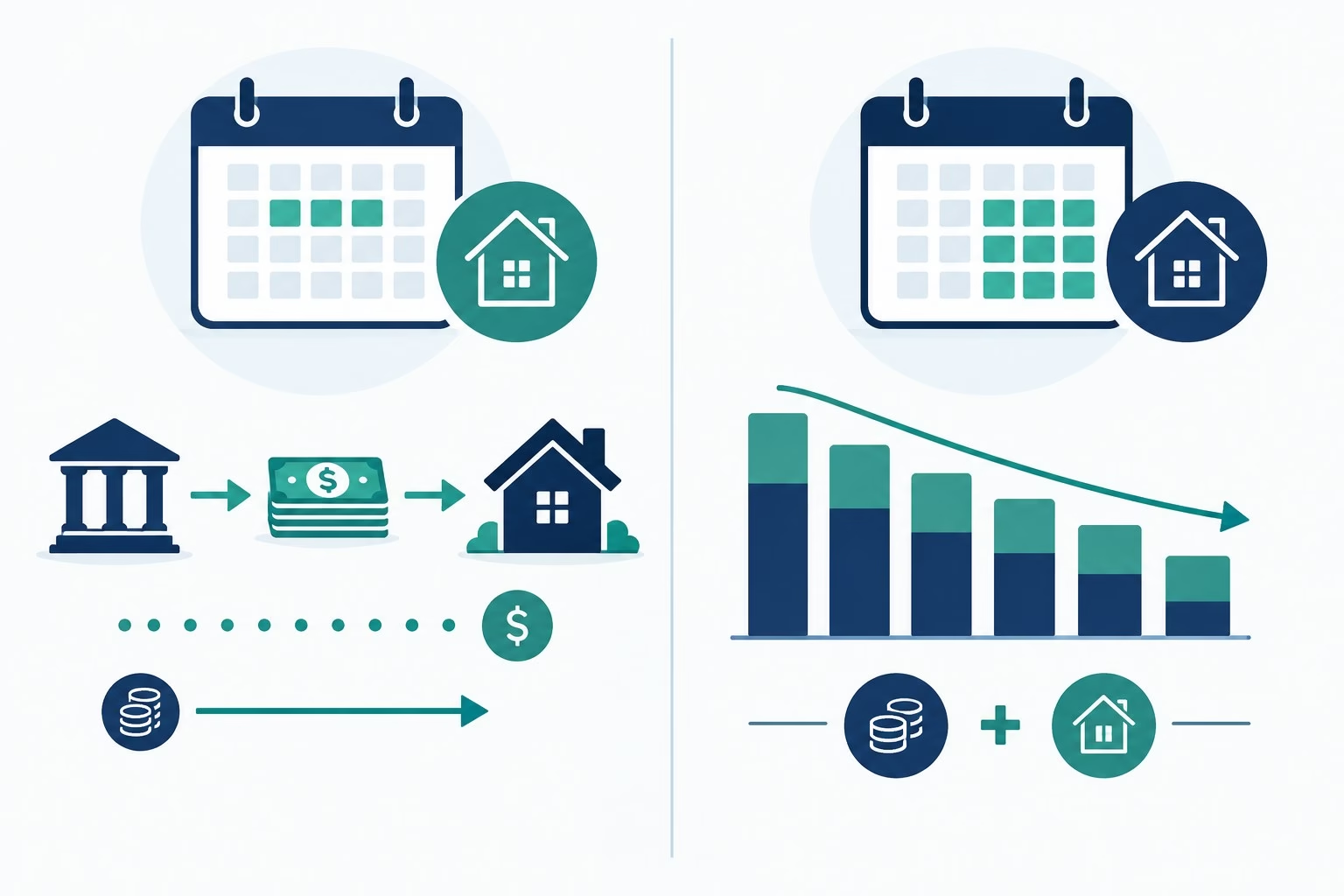
HELOC draw period ending: what changes when repayment starts?
A home equity line of credit is a revolving credit line secured by your home. Its agreement generally defines two stages: a draw period, when eligible borrowing is available, and a repayment period, when borrowing stops and the outstanding amount must be repaid. Specific lengths, payment formulas, and conversion provisions depend on the agreement. Never assume that your neighbor's HELOC works like yours.
During the draw period, some contracts permit interest-only minimum payments. Others require principal and interest, or give you a choice. Draw periods are often described in ten-year examples, but there is no single draw length that applies to all lenders. During repayment, many contracts amortize the outstanding principal over a specified term, such as ten or twenty years. The CFPB also notes that some plans require the entire balance when repayment begins, commonly called a balloon payment. Check the terms in your own note and disclosures rather than relying on a generic illustration.
Another detail matters: a HELOC usually has an adjustable interest rate. Even if you have been paying down principal, a higher rate can increase the required payment. A lender might also offer a fixed-rate conversion feature on part or all of a balance, but availability, conversion fees and pricing are contract-specific. The CFPB's HELOC explanation covers the repayment transition and this rate structure.
The two changes can arrive together: a shift from interest-only to principal-and-interest payments and a rate reset. Treat the expected payment, not the historical minimum, as the baseline for your affordability plan.
Illustrative payment shock: a $40,000 HELOC balance
Consider a homeowner with a $40,000 outstanding HELOC balance. Assume a constant 9.00% annual interest rate solely for illustration, with monthly calculations and no additional draws, fees, rate changes, or arrears. This is not a verified current HELOC offer or a market average.
| Illustrative arrangement | Approximate monthly payment | What the payment covers |
|---|---|---|
| Interest-only draw-period payment at 9.00% | $300 | Interest, no scheduled principal reduction |
| 10-year amortizing repayment at 9.00% | $507 | Principal plus interest |
| 15-year amortizing repayment at 9.00% | $406 | Principal plus interest over a longer term |
| 20-year amortizing repayment at 9.00% | $360 | Principal plus interest over an even longer term |
The monthly payment in this illustration rises from $300 to about $507 when the account begins a ten-year amortization—an increase of approximately $207 a month, or nearly 69%. That change occurs without assuming any rate increase. Extending amortization can lower the required payment but generally increases total interest paid, assuming the same balance and interest rate. A longer term is not automatically a better deal.
The examples use the standard fixed-rate amortization formula: monthly payment equals the principal multiplied by the monthly rate, divided by one minus the monthly discount factor over the total number of payments. Real HELOCs may have daily-interest accrual, adjustable rates, irregular payment rules, minimum balances and different conversion terms, so lender figures take priority over examples.
To stress-test affordability, also imagine the rate changes from 9% to 11% on an adjustable-rate line. The interest-only amount alone would become approximately $367 per month on an unchanged $40,000 balance. If a repayment reset follows, principal payments add another layer of cost. Do not interpret this as a prediction that rates will rise; it is a scenario to test your budget against uncertainty.
Action: Request the exact projected payment in writing from your servicer under today's applicable contract terms. Ask for scenarios at the rate cap and any adjustment dates, not just an initial payment quote.
Find these seven items in your HELOC paperwork
- Draw-period end date. Identify the precise date when new advances stop. Verify whether any pending withdrawals are permitted and whether exceptions apply.
- Repayment start date. Check whether there is any transition period and when the first new payment is due. Set a calendar reminder early enough to compare options before that date.
- Outstanding principal and accrued interest. Ask for a current payoff or balance statement. Interest owed may not be reflected in a rounded balance shown in a banking app.
- Index, margin, adjustment frequency, and caps. Understand what determines a variable rate and how often it may change. A quoted introductory APR may no longer apply.
- Repayment term and formula. Determine whether the contract calls for amortized principal-and-interest payments, a balloon payoff, or another structure.
- Fixed-rate conversion rights. Find out whether the lender permits conversion and what rates, deadlines, limits, or fees apply.
- Annual, termination, or other fees. Identify account fees and any early-closure or conversion charges, especially before refinancing into another product.
Build a single-page summary containing these details, plus the servicing phone number and your estimated monthly payment after conversion. If your lender's website offers a projection calculator, save the result and ask how it compares with the actual contractual billing formula. A customer service estimate is helpful, but your signed documents control unless modified in writing.
Four main options to consider before the transition
1. Pay down the HELOC principal while the draw period is open
If your budget permits, principal reductions before the reset can reduce the balance being amortized. For example, reducing a hypothetical $40,000 balance to $30,000 lowers an otherwise identical payment by 25%, because the payment in a constant-rate amortization model is proportional to principal. The interest savings can be meaningful, but avoid draining emergency reserves or leaving higher-cost debt unpaid without comparing the full household picture.
Confirm that extra payments actually reduce principal rather than being treated as a credit toward future installments. Ask how repayments affect the availability of the credit line and whether a new advance would undo the progress. Keep a record of every transfer and verify your next statement.
2. Ask the existing lender about modification or a fixed-rate conversion
Your lender may be willing to discuss available contract features, hardship assistance, a payment arrangement or new loan terms. A fixed-rate option may make the monthly bill more predictable, although it could carry a higher initial rate or additional fees. A modification is not guaranteed, and programs may depend on your account history, creditworthiness and hardship circumstances.
Before agreeing, request the proposed APR, payment, term, total expected finance costs, closing charges and whether your right to borrow again will end. Ask whether the change is a modification of the existing debt or a completely new secured obligation. Read the full documents before signing.
3. Explore a home equity loan or a new HELOC
A home equity loan commonly provides a lump sum and may have a fixed rate, while a HELOC usually offers revolving access and a variable rate. Both may be secured by your home. A new home equity loan could replace an expiring balance with an amortizing payment, but approval, closing costs and loan-to-value limits apply. A new HELOC may restart a draw period, yet it can postpone rather than eliminate the repayment problem.
Compare products on a full-cost basis, not just the advertised APR. The CFPB comparison of HELOCs and home equity loans explains how repayment and access to funds differ. Importantly, borrowing more than necessary can increase debt secured by your residence.
4. Evaluate cash-out refinancing or another payment plan
A cash-out refinance replaces an existing mortgage with a new, typically larger mortgage. That may simplify the number of payments, but it also changes the terms of the first mortgage. If your current first mortgage has a favorable rate, refinancing it just to pay a smaller HELOC can make the overall household financing substantially more expensive. Carefully compare the interest cost on the entire new mortgage, not only the HELOC portion.
Before applying, review our mortgage refinancing guide and fixed-rate versus adjustable-rate mortgage comparison for related concepts. A refinance may create a longer repayment horizon, upfront charges and new qualification requirements. In some situations, adjusting spending, paying down principal, or selling an asset can be less expensive than adding new debt.
Compare offers using total borrowing cost, not the headline APR alone
Interest rate and annual percentage rate are related but different measures. Depending on the loan type and applicable disclosure rules, APR can incorporate certain finance charges. HELOC disclosures may operate differently from closed-end mortgage APR disclosures, so ask lenders to itemize charges consistently and explain the applicable method. Never compare an introductory variable-rate HELOC quote with a fully amortizing fixed-rate home equity loan as if the two figures describe identical risks.
The CFPB identifies potential HELOC charges including application fees; origination, appraisal, title or other closing costs; inactivity fees; annual fees; early termination charges; and fixed-rate conversion fees. Not every lender imposes every fee, and a “no closing costs” advertisement may still carry ongoing charges or recovery conditions if the line closes early. Consult the CFPB fee overview.
| Question to ask | Why it matters |
|---|---|
| Is the rate fixed, variable or introductory? | Determines how much future payments may change. |
| What is the index and lender margin? | Explains how a variable rate is calculated. |
| What is the fully amortizing payment? | Shows an obligation beyond an interest-only minimum. |
| What fees are payable upfront and every year? | Reveals costs hidden by payment-only comparisons. |
| Is there an early closure or conversion charge? | Can offset the benefit of switching lenders. |
| Will refinancing change my first mortgage? | May reset terms on a much larger balance. |
| What is the worst-case rate under the cap? | Tests whether the household can absorb a rate change. |
Ask for written illustrations using the same loan amount and comparable repayment periods. A quote with a smaller payment can be attractive because it extends the term or delays principal, not because it is truly cheaper. An accurate comparison should consider monthly affordability and lifetime cost, together with flexibility and foreclosure exposure.
A five-step budget stress test before your payment changes
Step 1: Calculate your cash-flow gap. Subtract essential spending, minimum debt payments and realistic savings needs from take-home pay. Include seasonal insurance or property-tax bills instead of assuming every month has the same expenses.
Step 2: Test the projected new payment. Replace the current HELOC minimum with the lender's upcoming required amount. Note the monthly difference and annualize it. A seemingly small $200 increase becomes $2,400 across a year.
Step 3: Stress-test interest rates. If your HELOC remains variable, ask for a payment scenario at higher rates and at its contractually permitted cap. Avoid relying on market forecasts or assuming that current rates will hold throughout the repayment term.
Step 4: Protect a reasonable reserve. An emergency fund can prevent a temporary disruption from becoming a missed housing payment. Do not pay off the HELOC so aggressively that one car repair or health expense forces you into another expensive debt product.
Step 5: Establish a decision deadline. Allow time for document requests, competing lender applications, appraisals and closing. If the new payment is already unaffordable, speak to your servicer or an approved housing counselor promptly rather than waiting for delinquency notices.
Use the result to classify the transition as manageable, manageable only with adjustments, or requiring urgent assistance. The objective is to recognize a problem when you still have choices rather than after a late payment affects your credit or puts your home at risk.
Why using a HELOC to pay credit card debt can backfire
One common strategy involves moving high-interest unsecured balances into home-secured borrowing. A lower rate may reduce the monthly interest charge, but the underlying risk changes dramatically: missed payments on a home-secured loan can threaten ownership of the property. If the original credit cards are used again, a homeowner may end up carrying both forms of debt.
The proper comparison is not simply “credit card APR versus HELOC APR.” Consider all fees, future rate changes, payoff time, the chance of new card spending, the impact on equity and the household's ability to keep paying during unemployment or illness. A nonprofit credit counselor may be helpful before pledging home equity to solve unsecured debt.
The tax treatment also differs from a popular misconception. The IRS explains that interest on home equity borrowing used to pay personal debts such as credit cards does not qualify for the home-mortgage interest deduction. Potential deductibility for qualifying home improvements depends on additional conditions and limits, including itemizing where applicable. Review the IRS Publication 936 and seek individual tax advice rather than assuming a HELOC automatically produces a tax benefit.
What if the new HELOC payment is unaffordable?
Contact the servicer early. Explain that the draw period is ending, provide a realistic monthly budget, and ask which options exist for your specific account. Request written details of any proposal and clarify whether it changes your rate, payment, maturity date, or rights under the original contract. Do not assume a payment extension has taken effect until it is confirmed.
Consider working with a HUD-approved housing counselor, particularly if you are also behind on a first mortgage. The CFPB notes that a housing counselor may help homeowners assess alternatives before taking out additional home-secured debt. Be cautious of firms that demand large upfront fees while promising guaranteed mortgage relief or immediate debt elimination.
If foreclosure notices have arrived, deadlines and procedures depend on the state and the documents involved. Qualified local legal help may be important. A missed HELOC payment is not merely an inconvenience if the debt is secured by your property. Address the problem before rolling late fees and default-related expenses make repayment harder.
Can you cancel a new HELOC after signing?
Some borrowers seek new financing late in the draw period and then discover fees or terms they did not expect. For certain principal-dwelling HELOC transactions, federal rules provide a right to cancel within three business days after the applicable triggering event. Rules and exceptions matter; do not assume every mortgage transaction has an identical cancellation period.
According to the CFPB, for a HELOC secured by a principal dwelling, the right may be exercised within three business days after opening the account or receiving required opening disclosures, whichever is later. The CFPB discussion of HELOC disclosure changes explains the rules in greater detail. Read your own notice of the right to cancel and follow its procedure, including any written notification requirement.
Do not mistake rescission rights for a substitute for careful comparison before signing. A decision about home-secured debt merits sufficient time to review term sheets, costs, affordability and contingencies.
Questions to ask three prospective HELOC or home equity lenders
Comparison shopping is useful only when the questions reveal the true differences. Ask each institution to evaluate the same proposed loan amount and provide written terms that can be compared side by side.
- What is the current available rate or APR for my verified qualifications, and how long is the quote valid?
- Is any introductory rate temporary? What happens when it expires?
- What index, margin, adjustment interval, floor and cap apply?
- Can the full amount be borrowed immediately, or do minimum advance rules apply?
- How will the payment be calculated during both draw and repayment periods?
- What principal-and-interest payment is projected after the draw phase?
- Are appraisal, title, origination, annual, inactivity, cancellation or conversion fees charged?
- Can the rate be fixed on all or part of the outstanding balance, and at what cost?
- What happens if home values fall or credit conditions change?
- Can the lender provide a full schedule or representative total-cost illustration?
Keep screenshots or PDFs of the answers. An offer appearing inexpensive on the lender's home page may not be available for your credit score, property type, loan-to-value ratio, occupancy status or state. Do not publish comparisons implying a lender's lowest advertised rate is available to every borrower.
HELOC versus home equity loan versus cash-out refinance: decision framework
| Option | Potential appeal | Main caution |
|---|---|---|
| Keep existing HELOC and repay | No need to initiate a new secured loan if affordable. | Variable rate and increased amortizing payment may strain cash flow. |
| Ask for a lender modification or fixed-rate conversion | May simplify planning without moving the loan. | Not guaranteed; restrictions, rate differences and fees can apply. |
| Take a home equity loan | A fixed payment may improve predictability. | Upfront costs, qualification requirements and home collateral risk. |
| Open another HELOC | May offer flexible draws under a new agreement. | Can simply delay a future payment shock and prolong debt. |
| Cash-out refinance | May consolidate mortgage-related balances. | Reprices the entire first mortgage and may add substantial costs. |
A cash-out refinance deserves particular care if you locked a low first-mortgage rate years earlier. Compare the additional interest on the original mortgage balance under the new rate, not merely the dollars used to pay off the HELOC. The smallest monthly payment is not necessarily the safest or cheapest strategy.
For a household close to retirement, flexibility may matter more than access to additional credit. For a homeowner with variable income, the predictability of fixed principal-and-interest payments may deserve extra weight. For someone expecting to sell a property soon, short-term fees and payoff conditions become crucial. A good recommendation depends on the actual timeline and cash flow rather than a generic product ranking.
HELOC tax deduction: what homeowners should verify
Some advertising and internet articles treat HELOC interest as generally tax-deductible. That is misleading. Under the IRS framework explained in Publication 936, the use of the proceeds is central: interest may be deductible only where funds are used for qualifying home acquisition or improvements and the applicable other requirements and limits are met. Using the line for groceries, travel, credit cards or other personal expenses is not the same as using the proceeds to improve the qualified residence securing the loan.
The result also depends on factors such as whether the taxpayer itemizes, the residence and security interest, debt limits and the tax year. Tax law can change, and an article cannot confirm an individual's eligibility. Retain invoices and records showing how proceeds were used, and ask a qualified tax professional to review uncertain or mixed-use situations. Treat any potential deduction as a possible secondary consideration, not the reason to take on home-secured debt.
HELOC draw period ending: what to do 90, 60 and 30 days before
About 90 days before
Review the original HELOC agreement, find the repayment date and ask the lender for the anticipated payment and current balance. Calculate a budget using the proposed principal-and-interest amount. Check your first mortgage rate, credit information and equity position. Research whether the existing lender offers a conversion or modification and identify appropriate competing institutions.
About 60 days before
Collect quotes from several lenders if refinancing remains a realistic option. Compare APR definitions, payment structures, borrowing limits, fees and risks. Estimate the total cost over your likely ownership horizon. Avoid submitting applications for loans you do not understand, and do not borrow a larger balance solely because a lender approves it.
About 30 days before
Choose a practical path: make a principal payment, proceed with an acceptable written modification, finalize a well-understood refinance or prepare to absorb the new repayment amount. Confirm autopay instructions and sufficient funds. Save all confirmations, track the due date, and speak to the servicer again if your projected payment differs from the billing notice.
If the transition is already less than a month away, compress the timetable but do not skip the document review. An urgent deadline can make aggressive financial advertising especially tempting; prioritize transparent lenders, official guidance and a realistic budget.
Frequently asked questions
Does a HELOC automatically renew after ten years?
No. Whether it renews depends on the contract and the lender's approval rules. Some borrowers must repay their existing balance, and some may be offered a new line or a different loan subject to underwriting. Never plan around an automatic renewal unless the lender confirms it in writing.
Why can payments increase even when interest rates stay flat?
An interest-only payment covers interest but does not require routine repayment of principal. Once principal must be amortized over a fixed term, the scheduled payment usually increases even if the interest rate is unchanged. A shortened repayment horizon makes that effect larger.
Can a lender freeze a HELOC before the draw period ends?
In certain circumstances a lender may reduce or suspend access to a line of credit, such as a substantial decline in property value or changes in a borrower's financial condition. Specific legal conditions govern those actions. The CFPB HELOC guidance discusses potential restrictions.
Is a home equity loan always safer than a HELOC?
No. A fixed-rate installment schedule can improve payment predictability, but both can be secured by your home. A larger borrowing amount, unaffordable payment, expensive fees or an unnecessarily long term can make either product risky.
Can I deduct HELOC interest if I used the money for credit card debt?
Generally, no under the federal home-mortgage interest rules discussed by the IRS, because proceeds used for personal debt do not meet the qualifying home-acquisition or improvement use test. Consult the IRS guidance for your tax year and facts.
How early should I speak with my lender?
As soon as the end date is known. A three-month planning window is a useful organizational example, but it is not a regulatory deadline. If repayment is already unaffordable or an account is delinquent, contact your lender and seek qualified counseling immediately.
Bottom line
A HELOC draw-period reset is not automatically a financial emergency, but it can turn an affordable interest-only payment into a much larger obligation. The key is to calculate the real upcoming payment, understand rate exposure, compare complete costs and act while alternatives remain available.
Start with your lender's written repayment schedule, your household cash-flow test, and a side-by-side evaluation of available options. Keep your home's foreclosure risk central to the decision. For our approach to comparing financial information, see the Meridian Pioneer research methodology and editorial policy.